Feb 20, 2012
Transcript
JAD ABUMRAD: Hey, I'm Jad Abumrad.
ROBERT KRULWICH: I'm Robert Krulwich.
JAD: This is Radiolab. And today ...
[ARCHIVE CLIP: We offer you escape!]
JAD: We're talking about escape.
ROBERT: Stories about people being trapped and then getting out, getting free.
JAD: And in our last segment we met a guy for whom, well, the escape itself became a trap.
ROBERT: But now we're gonna take our escape motif to a much bigger scale.
JAD: Yeah.
ROBERT: And we're calling this, by the way ...
[ARCHIVE CLIP: The outer limit.]
ROBERT: Because in this one we're going to the outer limits of the human imagination.
JAD: It began for us when we spoke with this writer ...
ED DOLNICK: Yes, I hear you booming.
JAD: Ed Dolnick is his name. And he told us a story about ...
ED DOLNICK: So this is Isaac Newton's story, for the most part.
JAD: And it's a story that involves the Earth, the heavens, God, humanity, and you might as well throw in the apple.
ED DOLNICK: The one thing everybody knows about Newton is that an apple fell from a tree and bonked him on the head.
JAD: Which isn't true, I was told. Right? Isn't that apocryphal?
ED DOLNICK: It's probably not true, but it's a story that Newton himself told.
JAD: Oh, really?
ROBERT: Oh!
JAD: Because Newton, according to Ed ...
ED DOLNICK: All his life had this notion that he was different from other people. Not only different from, but better. He had a pipeline to God. God was whispering secrets, the secrets of creation into his ear. No one else had been blessed in this way. Other people's role in life was simply to bog him down.
ROBERT: [laughs]
ROBERT: Not what I would call a modest guy.
JAD: No. But ...
ED DOLNICK: At any rate ...
JAD: Our story begins around 1665. Newton is at Cambridge. He's a student.
ED DOLNICK: And Cambridge is hit by the plague. They send everybody home, because although nobody understands how the disease works, they know that if people are crowded together they tend to all get it. So everybody go your separate ways.
ROBERT: So this is kind of an enforced summer vacation.
ED DOLNICK: [laughs] Right.
JAD: And he's like 19 or 20 at this point?
ED DOLNICK: He's 21, 22.
JAD: Okay.
ED DOLNICK: Newton goes home to his mother's farm.
JAD: Mom is like, "Cool, now you can help me on the farm." But ...
ED DOLNICK: He says no.
JAD: Because he has a plan. He brought some books home.
ED DOLNICK: A bunch of textbooks.
JAD: And he locks himself in his room.
ED DOLNICK: And sets himself not only to having mastered all the science that had ever been done, but to plunging on ahead of everyone else on his own, motivated by this religious faith that everything in the universe was set up by a god who wanted someone to crack the code. Newton believes he's the one.
JAD: I mean, what was he doing in his room? Was he sitting there with a thousand giant textbooks?
ED DOLNICK: All that's known is that he did this.
JAD: He just went into his room and came out with what we're about to talk about.
ED DOLNICK: He came out with how gravity works, how light works, how rainbows work, how the tides work. And then, having done all that ...
JAD: In a [bleep] summer he did all this?
ROBERT: [laughs]
ED DOLNICK: Yeah!
ROBERT: What did you do on your summer vacation, Jad? I know my summer, I learned how to fold sheets like Marines do, which I thought was pretty good too.
ED DOLNICK: Right.
ROBERT: So after having one flash of insight after another, Newton now sets his mind to one of the great problems of all time, which for our purposes we will call the problem of the moon.
JAD: And just to set this up ...
ED DOLNICK: What everybody before Newton and Galileo thought is there were a bunch of ordinary things here on Earth, like rocks, and they behave in the ordinary way that we know.
JAD: You know, pick up a rock, let go, it falls.
ED DOLNICK: And there are a bunch of much more different, mysterious, elegant, perfect things in the sky.
ROBERT: Like the moon. Which doesn't fall, it just floats there.
JAD: So one could conclude that the moon has its own separate set of laws.
ED DOLNICK: There are one set of laws that work here on Earth, and another set that work in the heavens. And there's no reason it should be the same set of laws any more than New York's laws should be the same as Paris's laws.
JAD: Kind of makes sense, actually. Heavenly things float. Earthly things fall.
ROBERT: But then here's where the problem begins: Newton and a bunch of people at that time had gotten a hold of this newfangled thing called a telescope.
JAD: And one of the things they saw ...
ED DOLNICK: ... was that the moon wasn't this mysterious, heavenly body that they see. It was a big rock. A regular, lumpy, potato-ish rock.
JAD: Uh-oh. People were like "Huh."
ROBERT: But Newton being, of course, Newton thought, "Now wait a second."
ED DOLNICK: If the job of a rock is to fall, and if the moon is just another rock ...
ROBERT: Why doesn't it fall down?
ED DOLNICK: Exactly so. What's it doing sitting up there night after night?
JAD: Good question. And it's at this point that Newton, sitting in his room or wherever he was we can imagine, makes a crazy mental leap. He thought back to a little thought experiment that Galileo had come up with, which initially might not make much sense, the connection ...
ROBERT: But it pays off.
ED DOLNICK: And here's the set up: you've got someone standing in a big field with a gun that he's about to shoot. And next to that person with this gun is a person holding in his hand a bullet.
JAD: So you've got a person holding a gun and a person holding just the bullet side by side.
ED DOLNICK: And the bullet in the hand and the bullet in the gun are exactly the same height above the ground. Now somebody says, "Ready, aim, fire." And at the instant he says "Fire," the man with the gun shoots that bullet horizontally, and at that same instant the man next to him holding the bullet in his hand opens his hand and the bullet drops.
ROBERT: So there's one bullet zipping along and then falling, and then the other one just falls.
ED DOLNICK: Right. We shoot the bullet out of the horizontal gun, and we drop the bullet from right next to the gun.
JAD: At the same time.
ED DOLNICK: Yes. Both bullets will hit the ground eventually, but when they do they'll be far apart. And Galileo's riddle was: which of those bullets hits the ground first?
JAD: Well, I mean, that's ...
ROBERT: Everybody would know that the one that would hit the ground first is the one that you just dropped because the other one has to go all that distance.
ED DOLNICK: So this is a hard riddle. And the answer is ...
JAD: Well, wait. Why is it such a hard riddle? Because I would think that the bullet you drop is just gonna hit first. The gun's gotta go all the way.
ED DOLNICK: No. Those two bullets both hit the ground at the exact same instant.
ROBERT: Really?
ED DOLNICK: That's an experimental fact.
ROBERT: The bullet from the gun and the bullet from the hand lands at the same time?
ED DOLNICK: Yes. This bullet that shot horizontally, it doesn't go like Wile E. Coyote running off a cliff. It doesn't go straight, straight, straight, straight and then fall. It's curving as it goes.
JAD: And the thing that causes it to curve as it goes, of course, is gravity. It's the same gravity that is pulling the bullet that you drop. Same gravity. Same pull. Same speed. So counterintuitively, when you drop a bullet and it falls for this long, when you fire the gun it'll also fall for that long, even though it ends up a mile away. See? That was Galileo's riddle.
ED DOLNICK: And that's as far as Galileo took it.
JAD: Yeah.
ED DOLNICK: Newton looked at that and he said something smart.
JAD: First thing he said is, "Okay, this field? Let's not pretend that this is some ..."
ED DOLNICK: "Perfectly flat field that goes on forever."
JAD: "No. We're on the Earth, and the Earth is round."
ED DOLNICK: And what roundness means is that the ground curves away below horizontal.
ROBERT: So really what's happening is that as the bullet is shooting across the field and falling to the Earth, the Earth at the same time is very gradually curving away from it.
JAD: Now of course, most guns, you know, they don't shoot the bullet very far, and at that short distance the field is still pretty much flat.
ROBERT: But here's what Newton thought: "What if you could find ..."
ED DOLNICK: "Just the right gun."
ROBERT: "That could shoot that bullet not just across a field but across thousands of miles. And ..."
JAD: "What if ..."
ED DOLNICK: "As it falls ..."
JAD: "That bullet curves down towards the Earth ..."
ED DOLNICK: "In just the same as the Earth is curving ..."
JAD: "Away from it?"
ROBERT: In this scenario ...
ED DOLNICK: The bullet that we've shot will keep falling and falling and falling, but the Earth keeps falling and falling and falling away from the bullet. So the bullet falls forever, the Earth curves forever, the picture never changes.
JAD: So the bullet then does what?
ED DOLNICK: The bullet is in orbit. Hundreds of years before Sputnik and other satellites, Newton has invented the satellite. And on top of that, he said, when we see rocks like the moon that are not falling, the reason we think they're not falling is because we misunderstand. Really, just as the gun launched a bullet on Earth and it goes and never falls, God who is presumably a terrifically strong pitcher, launched the moon around the Earth at just such a rate that that would continue in its circle around us forever. This is a perpetual dance. The partners are bound together, but they never come close and they never break up, either. It's this endless round.
ROBERT: From which there is no escape.
ED DOLNICK: What this does, what Newton did is take the moon out of the domain of poets and musicians, the golden orb and this kind of thing, and lasso it to the same rules that we use here on Earth.
JAD: In other words, what he showed was that in a very real way, there's no separation between us and the heavens.
ED DOLNICK: The same set of laws does govern everything. "It's one universe and I've explained it all."
ANN DRUYAN: And once you figure out the laws of gravitation, then you can send spacecraft to ...
JAD: Mars ...
ANN DRUYAN: Jupiter ...
JAD: Saturn. Anywhere.
ANN DRUYAN: Out there.
JAD: If you're a Radiolab listener from way back, you might recognize that voice. That's Ann Druyan.
ANN DRUYAN: Hi.
JAD: One of the first stories we did, actually. I interviewed her about working on the famous golden record. You remember this.
ROBERT: Sure.
JAD: So the idea at the time was to put this record on the Voyager capsule, send it into space, and on the record would be all these sounds that represented, you know, us.
ANN DRUYAN: A kiss. A mother's first words to her newborn baby. Mozart.
JAD: In any case, Ann was the one who was in charge of choosing all the sounds to put onto that record. She and Carl Sagan worked together on that project. And here's the thing: we stopped our story as the rockets took off, but obviously that was just the beginning of the story. And the Voyager capsules right now, are about to make a kind of escape that Newton could have only dreamed of.
LYNN LEVY: Okay.
JAD: The record thing.
JAD: And our producer Lynn Levy has been ...
LYNN: Sorry, I just turned my headphones up way too loud.
JAD: ... has been following this story.
LYNN: Ow!
JAD: Yeah, just turn it down.
LYNN: Yeah.
JAD: Okay, so pick it up where we left off.
LYNN: Okay, so, like, the point of the mission wasn't really to deliver this record. It was to go out and look at all the planets in the outer solar system.
JAD: Mm-hmm.
LYNN: So starting in 1977, these two little spaceships ...
ANN DRUYAN: Two spacecrafts, Voyager 1 and 2 ...
LYNN: ... went racing away from Earth snapping pictures.
ANN DRUYAN: And so every time Voyager would reach another planet, you know, all of the Voyager people would get together, go into the imaging room, and see the pictures come from the outer solar system.
LYNN: Do you remember seeing them?
MERAV OPHER: I remember as a child seeing them in Life Magazine. You know, I was seven when Voyager was launched. So ...
LYNN: This is Merav.
MERAV OPHER: I'm Merav Opher, professor at Boston University.
LYNN: As a grownup, she became part of the Voyager team.
MERAV OPHER: All the pictures that as a kid you look at the books and to see how Neptune looks, how Jupiter looks.
ANN DRUYAN: You know, just a complete revelation.
MERAV OPHER: Saturn.
ANN DRUYAN: The image of Saturn.
MERAV OPHER: Technicolor.
ANN DRUYAN: Like pink and ...
MERAV OPHER: reddish.
ANN DRUYAN: ... turquoise colors ...
MERAV OPHER: Yellow and ...
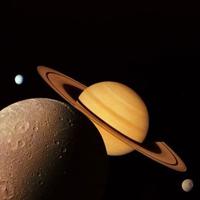
LYNN: And those rings. Just spectacular. They could see active volcanoes on one of the moons of Jupiter.
ANN DRUYAN: Finally, that vision of Neptune, of this blue jewel.
LYNN: Really blue.
MERAV OPHER: It all came from Voyager. We had no idea how they looked like before Voyager.
LYNN: Neptune was the last big, cool planet, and it was the last thing that they were supposed to photograph. After that ...
MERAV OPHER: The cameras were going to be shut off to save energy.
LYNN: But ...
MERAV OPHER: Carl Sagan convinced them to turn Voyager back to Earth and take a final picture.
LYNN: So on Valentines Day, 1990, one of the ships slowly rotated so it was facing back to Earth, and it snapped a picture.
ANN DRUYAN: One last picture.
JAD: Describe it.
LYNN: So it's mostly empty. It's pretty dark. You can see sort of streaks of light coming from the sun. And then you honestly wouldn't notice it if it wasn't pointed out to you, but down in one corner ...
ANN DRUYAN: Kind of suspended in a sunbeam ...
MERAV OPHER: There is a very small dot of blue.
ANN DRUYAN: A pale blue dot. That was us.
LYNN: In Carl Sagan's words ...
ANN DRUYAN: "Everyone you ever knew, everyone you ever loved, every superstar, every corrupt politician, just everyone in all of history, everything, the sum total. Think of the rivers of blood that have run so that one indistinguishable group could have momentary domination over a fraction of that pixel."
LYNN: It was one of those really rare images.
ANN DRUYAN: Every single day I would hear from people who take that pale blue dot so deeply to heart.
LYNN: It was a complete reframing.
MERAV OPHER: After that, the cameras were turned off.
LYNN: But here's the thing: the ships kept going, drifting through the darkness. Even though they weren't taking pictures anymore, they were using, like, their other senses: little instruments that detect how many particles are around, what the temperature is. So they were hurtling through this empty space really fast, measuring, sending that data back, and scientists like Merav were there listening and waiting.
JAD: For what?
MERAV OPHER: It was not clear.
LYNN: But they knew at some point these capsules would get to the edge.
JAD: The edge of what?
LYNN: The solar system.
JAD: The solar system has an edge? I thought it was just a big spiral.
LYNN: It has an edge. It's like a bubble.
MERAV OPHER: See, the sun has a wind. Every star has a wind, but the sun has its own wind.
LYNN: That blows out through the solar system.
ANN DRUYAN: It's very fast.
MERAV OPHER: It can be between 400 to 800 kilometers per second.
LYNN: Anyway, it blows out from the sun, past all the planets, and it keeps everything else out.
JAD: Oh, so it's like blowing up a balloon?
LYNN: Yeah.
JAD: The wind gives it a shape.
LYNN: Right. So these little things are cruising out towards this edge, wherever it is. Scientists don't quite know where it is or what it is. The guys in the control room are pinging the ships and, like, "Hey, what's up? What do you see?" And the ships are like, "Nothing." "Well, how about now?" "Not much." "Now?" "Nothing."
JAD: And how long before they actually see something?
LYNN: 14 years.
JAD: Oh, man. That's like driving through Kansas but, like, a million times worse.
LYNN: But, there comes a day ...
MERAV OPHER: End of 2004.
LYNN: Where they stop listening for a while because NASA only has so many antennas, and they have to use them to listen to everything.
JAD: Mm-hmm.
LYNN: So for a little while, the Voyager team's like, "Okay, you guys over there can use the antennas. We're going to lunch."
JAD: Yeah. I mean it's not like anything is happening.
LYNN: Nothing's happening anyways. It's been 14 goddamn years.
JAD: Knock yourself out.
LYNN: You guys? It's cool. And they come back a few hours later, start listening again, and ...
MERAV OPHER: It happened very sudden.
LYNN: ... everything has totally changed.
JAD: Really?
LYNN: All of a sudden? Boom!
MERAV OPHER: The speed of the wind dropped from around 380 kilometers per second to 100.
LYNN: Instantly. Just like all at once.
MERAV OPHER: Instantly.
LYNN: And then everything out there started to get messy.
MERAV OPHER: Very turbulent. Much more turbulent than before. Particles are also behaving a very different way, and the fields are very weird.
JAD: The fields?
MERAV OPHER: The magnetic field?
LYNN: So just like the sun has a wind ...
MERAV OPHER: The sun has a magnetic field as well.
LYNN: The field starts at the sun and then curves out in this kind of graceful arc through the solar system.
MERAV OPHER: And how the sun rotates creates what people call a ballerina skirt.
LYNN: You know how, like, a skirt will flare if you spin around real fast?
JAD: Mm-hmm.
LYNN: That's apparently kind of what this field looks like.
JAD: Huh.
LYNN: But way out there, it seemed like the skirt had started to fray, maybe tear a little. Threads had broken off and seemed to be floating around on their own, not connected to anything.
JAD: So what does this all mean? I mean, if the fields are breaking down and the wind is dying down, you said the wind is what actually creates the space of the solar system, does this mean we're out?
LYNN: No. I kind of thought that was what was happening, but no. It's not out and it's not quite in. It's in the edge of the bubble.
JAD: It's in the edge?
LYNN: Yeah. But it's not like a little, thin edge, it's a thick edge.
JAD: Huh. So the edge isn't just a line that you cross, it's a place.
LYNN: Yeah.
ANN DRUYAN: And while we listened, the two Voyager ships moved through this edge for several years.
MERAV OPHER: Then something very interesting happened. The wind on Voyager 1 stopped.
JAD: Like completely stopped?
MERAV OPHER: Yeah.
JAD: So now we're out?
LYNN: No.
ANN DRUYAN: No.
LYNN: I mean ...
MERAV OPHER: This is what people thought. But the other measurements ...
LYNN: Like temperature, number of particles, the magnetic field ...
MERAV OPHER: Doesn't tell us we're out of the bubble. Nature surprised us again.
ANN DRUYAN: So now we think there's a place at the edge of our solar system.
MERAV OPHER: Right at the edge.
LYNN: The edge of the edge ...
ANN DRUYAN: That's utterly still. No wind at all. A pause.
MERAV OPHER: People are calling it a stagnation layer, and there is a big discussion as to why this layer exists and how thick it is.
ANN DRUYAN: And by how thick it is, she means when will it end? Because once we get past this ...
LYNN: So has anything ever crossed this boundary before?
MERAV OPHER: No. This will be the first man-made object to leave any star. And Voyager was right there, smiling, touching that boundary.
ANN DRUYAN: You know, you only do those things first once, like your first kiss and your first taste of alcohol. Your first time driving a car. The first time you see the ocean. These things open up a whole new world. The first time out of the solar system.
JAD: So when is it gonna freakin' happen?
LYNN: It might've happened while we were talking.
JAD: Gah!
MERAV OPHER: We're thinking from now, any moment now, next couple months, or three years from now, four years from now. It's close.
LYNN: Every day I open my Google alert for Voyager and I look and see did it happen today?
JAD: Do you really?
LYNN: Because if it happens before this show goes out I'm gonna be pissed.
JAD: Every day?
LYNN: Yeah.
JAD: It's the first thing you do in the morning?
LYNN: No.
JAD: All right.
LYNN: Like, the third thing.
ROBERT: Thanks to Ed Dolnick. His book is called The Clockwork Universe.
JAD: And thanks to producer Lynn Levy, Merav Opher at Boston University, and Annie Druyan.
[ED DOLNICK: This is Edward Dolnick.]
[ANNE DRUYAN: This is Annie Druyan.]
[MERAV OPHER: I am Merav Opher.]
[ANNE DRUYAN: And here it goes.]
[ED DOLNICK: Radiolab is produced ...]
[ANNE DRUYAN: ... by WNYC ...]
[MERAV OPHER: ... and distributed by NPR.]
[ANSWERING MACHINE: End of message.]
-30-
Copyright © 2023 New York Public Radio. All rights reserved. Visit our website terms of use at www.wnyc.org for further information.
New York Public Radio transcripts are created on a rush deadline, often by contractors. This text may not be in its final form and may be updated or revised in the future. Accuracy and availability may vary. The authoritative record of programming is the audio record.