Aug 19, 2010
Transcript
JAD ABUMRAD: This is Radiolab. I'm Jad Abumrad here with Robert Krulwich. This hour we're looking at the science of emergence, how the world often seems to organize itself into being without an obvious plan—or a leader.
STEVE STROGATZ: Well, think about an ant colony or termites, right? I mean, they're trying to build a nest.
JAD: Mathematician Steve Strogatz.
STEVE STROGATZ: And if you look at any individual termite, it's just moving along and its antennas are wiggling and it's smelling pheromones, and it has no idea what it's doing. It doesn't know it's trying to build a nest, it's just responding to whatever little chemical is right in front of its nose. And yet out of this you see a coordinated group that looks like it's—you know, everybody knows what they're doing, but in fact nobody knows what they're doing. And the same thing with your brain: no cell in your hundred billion cells in your brain is having a thought, but together they are. Together they're falling in love or—or wanting to write music. So who's in there?
JAD: Do we have any idea why this happens? Or how, I guess?
STEVE STROGATZ: That's—that's the question.
ROBERT KRULWICH: And it's a really fascinating question when you really kind of pause to think about it. For example, look, I have here, you see this, this is my cup of coffee.
JAD: Mm-hmm.
ROBERT: I'm looking at it and, you know, it's a cup of coffee. But how does my brain know that this is a cup of coffee?
STEVE STROGATZ: It's—it's something that's, in a way, it's hard to even understand what the question is because this comes so naturally to us, right? We just look at something and we have this integrated perception of a cup of coffee. They're like, "What's the big mystery?" I hear you did—you used Oliver Sacks? Had him on the show recently?
ROBERT: Yeah. Uh-huh.
STEVE STROGATZ: He would probably be able to talk to you in an interesting way about people for whom this does not come easily.
OLIVER SACKS: It's a famous case which was reported in Germany of a woman who had lost motion perception, and there's a very nice description, for example, of her difficulty pouring tea.
ROBERT: So that's Oliver. Now this woman, she takes the teapot and she starts to pour, and suddenly the image just freezes.
OLIVER SACKS: She would have stills lasting about 15 seconds. She would see a glacier—she used that term—a glacier of fluid coming from the teapot.
ROBERT: Her brain was seeing something not moving, but then her feet were getting ...
OLIVER SACKS: And then suddenly there was a puddle.
ROBERT: ... they were getting wet.
OLIVER SACKS: And indeed crossing a road, it was impossible for this woman in Germany to do it.
STEVE STROGATZ: And so it's those people who help us realize the miracle of perception, right? That to see the world as a coherent thing is a miracle.
MAN: Should we hit them at the same time?
JAD: No. Just think of yourselves as fireflies and you're all buzzing in separate crates.
JAD: Okay, so back to your miracle of the coffee cup?
ROBERT: So yes, for those of us who are healthy, we do this all the time. The question, however, remains: how? I have trillions and trillions of neurons in my head firing randomly. Every neuron that you're hearing here is going a little—doing a little electrical thing.
JAD: Mm-hmm.
ROBERT: And now the question is: how does this, which seems so rampantly disorganized, how does it resolve ...
[singing "Coffee!"]
ROBERT: ... into a cup of coffee? How?
JAD: Good question.
ROBERT: Now a few years ago, a number of neurologists trying to figure out how the idea of coffee comes to be came upon a kind of musical analogy: that a brain creating a thought, creating, say, a cup of coffee is kind of like a musical event. Neurons in one side of the brain and another side of the brain are recognizing color or shape or something, and if they vibrate together ...
STEVE STROGATZ: At about 40 cycles a second ...
ROBERT: ... if they create, say, the same note ...
STEVE STROGATZ: ... in step ...
ROBERT: ... that synchrony is a cup of coffee.
[ARCHIVE CLIP, man: You ready?]
STEVE STROGATZ: What's happening in the brain is that there's a part of the brain responsible for the sense of smell.
[ARCHIVE CLIP, man: Smell! Smell!]
STEVE STROGATZ: The neurons that recognize the coffee aroma are firing vigorously as they smell it. Meanwhile, there are color detectors that happen to notice that it's a, you know, a red mug.
[ARCHIVE CLIP, woman: Red! Red!]
STEVE STROGATZ: Shape detectors, part of the visual system that are noticing the edge of the cup.
[ARCHIVE CLIP, man: Round! Round!]
STEVE STROGATZ: At least what neurologists think is that it's the simultaneous firing of all of those that are looking at red and at sensing the aroma, it's the coincidence of their firing that's telling them this is one thing, this is not separate aromas and colors and shapes. This is a coffee mug. They'd be singing together.
[ARCHIVE CLIP, choir: Coffee!]
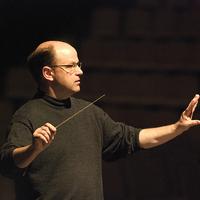
[ARCHIVE CLIP, conductor: No, no, no. One note. Come into alignment. One note.]
ROBERT: So that is a cup of coffee.
JAD: And to think we do it every morning. Before we proceed, we should thank the New York City LaGuardia Composition Class. Our neurons were ...
HARRY ZILL: My name's Harry Zill and I'm taste. Ahh!
MELANIE CHILDS: My name is Melanie Childs.
DANIELLE DEVITO: Danielle DeVito.
TASHA WIN: Tasha Win.
LAURIE DATIS: Laurie Datis.
JONATHAN CHU: My name is Jonathan Chu and I am smell.
JAD: Jonathan Chu, Mr. Smell, did the arrangements. Robert Apostle conducted.
ROBERT: Now, say, wait a second here, because this is interesting.
JAD: Hmm?
ROBERT: Robert Apostle ...
JAD: Yes?
ROBERT: ... their conductor told them what to do.
JAD: Right?
ROBERT: But in your head, when you think of a cup of coffee, who's conducting you?
JAD: Huh.
STEVE STROGATZ: And this is where we start getting into the very mystical or even most—most mysterious part of this is that who is it that's paying attention? I mean, because what is attention? How can you control—I don't really even know how to talk about this, but—but there's something in you that is—that is ...
ROBERT: Sends a signal, "Let's do coffee."
STEVE STROGATZ: Yeah. I mean, because it's confusing that—what is it that brings one thing into attention and not the other? Anyway, I don't know. I'm a little out of my depth here.
JAD: Somehow or other, whether we're looking at ants, cities or the internet, wherever we look, the shape and organization of the world seems to emerge without an obvious plan. And yet there it is. And nowhere is this more mysterious and more difficult to really comprehend than in our own heads.
ROBERT: Even for scientists who work on it day after day in the lab.
JAD: Like this guy.
CHRISTOF KOCH: Christof Koch. I'm a professor of neuroscience and engineering at the California Institute of Technology.
ROBERT: Christof Koch is one of the most celebrated neurologists in the world, and for him and for many others, they had a hard time getting rid of a model deep down which says somewhere in there there's a conductor. Someone is organizing the action.
CHRISTOF KOCH: You may remember there's a movie by Woody Allen called Everything You Always Wanted to Know About Sex ...
ROBERT: I do.
CHRISTOF KOCH: ... But Were Afraid to Ask.
ROBERT: Mm-hmm.
CHRISTOF KOCH: And there's this great skit in it where he has—a couple is petting in the back of a car.
[ARCHIVE CLIP: "Oh my God, Sidney. Can't you wait? You want to do it right here in the park."]
CHRISTOF KOCH: You see inside the boy's brain.
[ARCHIVE CLIP: "This is mission control. Mission control."]
CHRISTOF KOCH: You have this massive control room. You have these big TV screens corresponding to the output of the eyes.
[ARCHIVE CLIP: "Brain to eyes! Brain to eyes! Come in!"]
[ARCHIVE CLIP: "Eyes to brain. Over."]
CHRISTOF KOCH: And you have sort of all these white-coated technicians running around.
[ARCHIVE CLIP: "Proceed with erection. All systems go."]
ROBERT: And we're gonna get an erection in this scene, that's what we're trying to do?
CHRISTOF KOCH: Yeah, exactly. And then you have these—you know, all these semens that line up. They all have these little parachutes.
[ARCHIVE CLIP: "Attention, sperm! Attention, sperm! Stand by!"]
ROBERT: [laughs] They had long tails.
[ARCHIVE CLIP: "I'm scared. I don't wanna go out there."]
CHRISTOF KOCH: But I mean, the point is, though, there's this control room metaphor that—that we can all laugh about, but a lot of people, including scientists, have implicitly the idea is that me, there's a Christof who sits inside me. I can tell you, most people can tell you it sits exactly between my two eyes, between here and here.
ROBERT: And by the way, this Christof I assume would be saying, "Okay, she—" in the movie, he'd say, "Okay, she likes me. Let's make the next move."
[ARCHIVE CLIP: "Prepare for launching."]
CHRISTOF KOCH: That's exactly what happens, of course, in the Woody Allen movie. Exactly.
[ARCHIVE CLIP: "Prepare for launching. It looks like they're gonna do it!"]
[ARCHIVE CLIP: "See you guys in the ovary!"]
ROBERT: So the point, says Christof Koch, is that the Woody Allen model, this idea that there's an inner command center, some conductor directing your brain, that he thinks is wrong.
CHRISTOF KOCH: Now clearly there is no such person inside my head.
ROBERT: Well, how do you know?
CHRISTOF KOCH: Because who is sitting inside the head of this little Christof? And then who's sitting inside the head of the person sitting inside my head?
ROBERT: So you see the problem: if Christof is thinking about a cup of coffee and he gets the idea from an inner Christof who's thinking about a cup of coffee, where'd the inner Christof get the idea? Maybe from an inner, inner Christof?
CHRISTOF KOCH: That wouldn't really solve the problem. It would just push it one back.
JAD: These are heavy problems.
ROBERT: I mean, what happens here is we're tiptoeing up the hill here to the Mount Sinai of—of science.
JAD: Yeah. Coffee cups and people sitting at the controls, well these are kind of the smaller questions on the foothills to the bigger one, which is: how does a mind reflect?
ROBERT: Why does someone know who an "I" is?
JAD: Yeah.
ROBERT: Why can you contemplate death? What is this consciousness?
JAD: Right.
ROBERT: That's the big one.
JAD: If we can figure this out, whatever circuit is responsible for ...
ROBERT: Or circuits.
JAD: Or circuits that are responsible for human consciousness, think of what we could do: one day a doctor could walk into a patient's hospital room where the patient is laying comatose.
ROBERT: Mm-hmm.
JAD: And put a helmet on them, a conscious-o-meter, let's call it.
ROBERT: [laughs]
JAD: And measure how alive they are. Or maybe even tickle a part of their brain and wake them back up.
ROBERT: Hmm. This idea, by the way, came from one of the most famous scientists of the 20th century who worked very, very closely with Christof Koch. I'm talking about a man named Francis Crick. Now even if you know nothing about science at all, you've probably heard about the discovery of the structure of DNA, the DNA molecule by Watson and Crick. This is that Crick.
JAD: Hmm!
ROBERT: He was a British guy. He moved to Southern California, and at some point he and Christof Koch met. Now Koch was much, much younger, decades younger than the older guy, and yet they formed one of the more magical partnerships, a kind of Gilbert and Sullivan or Rodgers and Hammerstein of neuroscience. And one of the ideas that Crick had was that there is a way, there must be a way to figure out what consciousness is all about. They developed this notion.
CHRISTOF KOCH: There's no conscious entity inside my head that serves the role of conductor. That's not to say that there may not be places in the brain that act akin to a conductor, that sort of synchronize and that coordinate the various parts of the brain that fly independently. Because one of the remarkable phenomena of consciousness is everything's integrated. When I look at you and you talk, your voice comes out of your mouth. When you move, the motion I perceive is attached to your head. Now in the brain, all those things are analyzed in different parts of the brain, so you need some sort of entity that pulls all these different networks of the brain together.
ROBERT: Is there a place in the brain that does that?
CHRISTOF KOCH: Well, Sir Francis Crick and I think so. In fact, it was the subject of his last paper that he worked on literally on the day he died. There's this odd structure in the brain called the claustrum. Claustrum means "hidden away." And it's a small area. It's sort of an elongated, sheet-like structure beneath the cerebral cortex. You have two of them, one on the left and one on the right. And what's remarkable about it, indeed this structure receives input from almost every cortical area. It seems to be in an ideal position if you want to go to the metaphor of synchronizing all the different activities and making sure they're all in some sort of lock step.
ROBERT: So Francis and you have this idea, and he is very sick with cancer and he wants to get this idea down. What going—can you describe the scene there?
CHRISTOF KOCH: He first had this idea 10 years ago, and he talked about it in this—in this book that he published in '94, and then we never thought much more about it. Over the last year, we came back to this—this sort of somewhat obscure structure. So he was very, very interested in it. And yeah, he felt his—you know, as he felt his illness coming on and getting stronger, he was very adamant about trying to finish up a manuscript. So he literally worked days and days and days. There's this beautiful photograph of his desk covered probably four inches deep just with paper pertaining to the claustrum, and he worked in particular over the last six weeks trying to finish a manuscript or to get it in reasonable shape for us to publish.
ROBERT: And so he was—on the day he died, he was still writing?
CHRISTOF KOCH: A scientist to the bitter end.
ROBERT: There's a kind of Mozart's Requiem quality to this.
CHRISTOF KOCH: Yes. Yes. Yeah.
ROBERT: What was the last thing that you and he said to each other?
CHRISTOF KOCH: "I'll see you on Thursday or Friday." I was supposed to visit him in the hospital to work on this manuscript.
ROBERT: And was the manuscript completed?
CHRISTOF KOCH: No. So I'm currently working on it, editing it and then sending out. I'm about to send it out to friends and colleagues. Because I feel a little bit exactly like the student of Mozart whose name escapes me who finished his Requiem. He had a student who finished his Requiem, and now musicologists today are deciding what is actually original Mozart and what was finished in the style of Mozart. And so I'm very much aware of this.
ROBERT: [laughs] You should put your stuff in italics or something.
CHRISTOF KOCH: Something like that. On the other hand, we published 22 or 23 manuscripts together. And the way we always worked that he wrote the first draft, he was very insistent upon that, and then I would—you know, I edited and then he edited my edits, and so we iterated. Unfortunately, I can't do this here anymore, so I'm—you know, I just have to edit his draft without the benefit of his feedback.
ROBERT: Christof Koch is a professor of neuroscience and engineering at the California Institute of Technology. His newest book is The Quest for Consciousness.
JAD: There's more of Radiolab online at Radiolab.org. Communicate with us while you're there: radiolab (@) wnyc.org is the address. I'm Jad Abumrad. Robert Krulwich and I are signing off.
[LISTENER: John, somebody's gonna have to—who's gonna hold the phone? All right, Laura?]
[[singing] Radiolab is produced by Ellen Horne and Jad Abumrad. With help from Robert Krulwich, and production support from Sally Herships, Robert Krieger, David March and Amy O'Leary, Sara Peligrini, Michael Shelley. Special thanks to Elena Park and John and Leah and Laura Kipper and also to us: The LaGuardia High School Chorus! Goodbye.]
-30-
Copyright © 2024 New York Public Radio. All rights reserved. Visit our website terms of use at www.wnyc.org for further information.
New York Public Radio transcripts are created on a rush deadline, often by contractors. This text may not be in its final form and may be updated or revised in the future. Accuracy and availability may vary. The authoritative record of programming is the audio record.