Aug 19, 2010
Transcript
JAD ABUMRAD: This is Radiolab. I'm Jad Abumrad.
ROBERT KRULWICH: And I'm Robert Krulwich.
JAD: This hour we've been looking at morality, good and bad, right and wrong.
ROBERT: Now let us say that you are wrong, that you have done something bad and that the society around you says, you know, "You're guilty." If you go back 250 years, the city fathers of Philadelphia had an interesting way to make its citizens own up to their guilt.
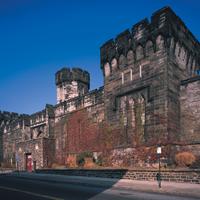
JAD: It is a giant gothic castle that still sits today in the middle of downtown Philadelphia, except it's no longer occupied and it's falling apart. We sent producer Josh Braun to take a look.
SEAN KELLY: Well, do you want to just walk over and look around a little bit?
JOSH BRAUN: Can we look around a little bit?
SEAN KELLY: Sure.
JOSH BRAUN: Get some ambience?
SEAN KELLY: Yeah, you bet. Come on in.
JOSH BRAUN: The building is truly a ruin.
SEAN KELLY: There used to be two huge oak doors here, and they had iron studs.
JOSH BRAUN: This building is based on a profoundly optimistic view of human nature.
SEAN KELLY: Imagine swinging this giant door open.
JOSH BRAUN: That all people are inherently good.
SEAN KELLY: And you being our new inmate, first you would have your head covered with a hood.
JOSH BRAUN: That every human being in their heart had an instinct to behave right, to do the right thing. So they argued for a prison that would house every man and every woman in a profound isolation. They thought that isolation would encourage spiritual reflection and the prisoners would become penitent. This is the world's first true penitentiary, a building designed to make someone penitent—genuinely sorry for what they did.
SEAN KELLY: We're gonna walk down here. They called this the south corridor, this big arched corridor.
JOSH BRAUN: Quaker prison reformers argued that inmates should be totally cut off from the outside world, and so they didn't allow them to get letters from home, they didn't allow them any books aside from a copy of the King James Bible. The actual example that they used was that if an inmate came into Eastern State before an election they shouldn't know the name of the President of the United States. They were looking for near total sensory deprivation. They wanted you to see the four white walls of your 8' by 12' cell and not a whole lot else. For years.
SEAN KELLY: So here you are inside of your cell. You can see it has a cot in it with a simple mattress stuffed with straw. And those are their tools for making shoes. The cell, what always amazes me every time is how high the ceiling is. 16-foot vaulted ceilings. It's got this beautiful arch to it. And then they have that skylight. They called them "The eye of God." Daylight came down through this circular opening that's supposed to mimic the look of an eye looking down at you. No, you're supposed to be going through a profound spiritual reflection while you're here, and so they wanted all the light to come down from above. And on a gray day like this, you really get a sense for how gloomy this—this cell would have been. You stay here for one sec and I'll be right back. I'll see you in a few minutes.
[door slams]
JOSH BRAUN: We have a letter from an inmate. He wrote to his mother saying, "I've just received word that I'll serve my sentence in Eastern State Penitentiary in silence and in incredible crushing isolation. Please endeavor to secure for me a pardon."
SEAN KELLY: The people who ran this prison were fascinated by silence. They just fetishized the idea of total silence. They wanted the inmate's life back here in these cells to be almost completely silent. And so as they walked up and down the corridors, the guards would put socks over their shoes so that you wouldn't hear the footsteps. And as they rolled carts of food to deliver meals here in the cells, they covered the wheels of the cart with leather so they would roll in silence.
JOSH BRAUN: A friend of my mother's was telling me about his time in the Peace Corps. And he was in Gabon, Africa. And he was in the jungle, and he said the jungle was so dense they would only carve out chunks of—of jungle big enough for the exact spaces that they needed—for little gathering spots or for their houses. But if they left something for a couple of weeks, it'd be just jungle again. And after two years of being in this village, he went off to visit a friend in Kenya and went out to the plains. And he said his eyes physically couldn't focus on distances further than about 10 feet out because they hadn't done it in two years. And he said the entire time when he was out there he felt exposed, like there was things behind him that he couldn't see. And all I could think about was the Eastern State Penitentiary and being in these little cells about 8' by 12' for years. And then you'd walk out and the first thing you see is the prison itself extended 680 feet in either direction. Must have freaked people out. You know, there was this growing debate that prolonged isolation could cause insanity, that it could cause emotional breakdown, so what looked to be optimistic in the 1830s looked pretty cynical by the 1860s. By about the building's hundredth birthday, they'd given up the idea of solitary confinement and they were holding inmates here for life sentences.
JOSH BRAUN: The walls were built with the idea that people are inherently good, and by the end they were housing all these inmates who apparently they had assumed were inherently evil.
SEAN KELLY: And lock up behind us. These days, our major security concern is people getting in—vandals, all that kind of stuff.
JAD: Josh Braun produced that audio tour with recording help from Sally Herships. And the voice you heard was Sean Kelly. For more information on Eastern State Penitentiary or the science of morality or anything that you heard this hour, visit our website. What's the address?
ROBERT: The address is, um ...
JAD: Come on. You should have it memorized by now.
ROBERT: Oh. Oh, Radiolab.org?
JAD: Radiolab.org. And while you're there, let us know what you think. Our email address is Radiolab(@)wnyc.org. I'm Jad Abumrad.
ROBERT: And I'm Robert Krulwich.
JAD: And we're signing off.
[DALE KEYES: Radiolab is produced by Jad Abumrad and Ellen Horne with help from Sara Pellegrini, Arwin Curry, Casey Edwards, Melissa Kebble, Robbie Krieger, Mary Lloyd, Amber Seely and Sarissa Tanner. Special thanks to David Martin and to the Vanderbilt Television Archives. And to me, Dale Keyes. Production management by Dean Capello and Mikel Ellcessor. Radiolab is produced by—oh! All right. Radiolab is produced by New York Public Radio-WNYC and distributed by NPR. [laughs]]
-30-
Copyright © 2023 New York Public Radio. All rights reserved. Visit our website terms of use at www.wnyc.org for further information.
New York Public Radio transcripts are created on a rush deadline, often by contractors. This text may not be in its final form and may be updated or revised in the future. Accuracy and availability may vary. The authoritative record of programming is the audio record.