May 4, 2009
Transcript
[RADIOLAB INTRO]
JAD ABUMRAD: Hey, I'm Jad Abumrad.
ROBERT KRULWICH: I'm busy listening to this. Who is this? I'm Robert Krulwich. This is Radiolab, the podcast.
JAD: So this person that you're hearing right now?
ROBERT: Mm-hmm.
JAD: Testing, testing.
JAD: She's one of my favorite, favorite musicians.
JAD: Can you introduce yourself? I am ...
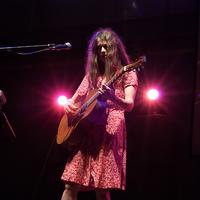
JAD: Her name's Juana Molina.
JUANA MOLINA: I'm Juana Molina, and I'm a musician. I hope you enjoy what I do.
JAD: Okay, so you know how sometimes on this podcast, instead of the science and the big ideas and the whatever, we present musicians?
ROBERT: Yeah.
JAD: Well, that's what I want to do for the next 10 or so minutes, both because I think she's amazing but also when we used her music in the Sperm show, I used it for some of the breaks—this song right here, in fact—we got a flood of email, people asking about it.
ROBERT: I wonder what she thought about being the breaks in the Sperm show. [laughs]
JAD: [laughs] She doesn't know!
ROBERT: [laughs]
JAD: So this podcast is for the bunch and bunch and bunch of people who wrote in asking about Juana Molina, and also for the rest of you who maybe don't know her yet but will hear her now and maybe I hope fall in love with her music as I have.
JAD: So let me make space here.
JAD: Okay. So I spoke with her recently as she was in town to play a gig at this club called Le Poisson Rouge.
ROBERT: Le Poisson Rouge. The red fish.
JAD: Yep. And she told me her backstory. It's kind of interesting. She started out as a musician, taking piano lessons and guitar lessons, trying to be a performer. It wasn't really working out at that point, so she needed a job. And she wasn't really sure what to do, but she knew she was always good at impressions.
JUANA MOLINA: It's something I could always do. And it was easy for me just to impersonate characters. And then ...
JAD: People that you knew or just ...
JUANA MOLINA: People like stereotypes. Or I don't know if it's stereotypes or archetypes. Both. I mean ...
JAD: That's interesting stuff.
JUANA MOLINA: Yeah. And then one day I was looking for a job that gave me enough money to play music. And I thought TV was the best option.
JAD: You went to TV to help pay for music?
JUANA MOLINA: Mm-hmm.
JAD: What she did was she went over to the local TV station, somehow convinced them to give her a job reporting fake news, sort of like The Daily Show. And eventually, she got her own show called Juana y sus Hermanas, which means Juana and her Sisters. It was sort of a comedy show.
JUANA MOLINA: It was just sketches.
JAD: How long did that go for?
JUANA MOLINA: Three years. At the beginning, it worked very well because I had money and I could pay my rent and my guitar lessons. But then I got big.
JAD: She became a huge hit.
JAD: Was it the kind of situation where you'd walk down the street and be recognized?
JUANA MOLINA: Yeah.
JAD: Much to her dismay, oddly. Suddenly she was an actress, not a musician. And as she puts it, her life got out of hand. But then she got pregnant.
JUANA MOLINA: I got pregnant and I needed to stay in bed. And so I had time to think about my life and realized that I had totally missed my goal. It was just that I didn't want to miss it. I didn't want to die and not having done what I wanted to do.
JAD: So at the height of her popularity as an actress, she drops out.
JUANA MOLINA: Yeah, that's not what I wanted. I just wanted to be a musician.
JAD: So she starts playing in these little clubs, just her and her guitar.
JAD: how did people respond?
JUANA MOLINA: Badly.
JAD: Didn't go so well.
JUANA MOLINA: It was hell for several years.
JAD: She said she had terrible stage fright.
JAD: You're an actress. Wouldn't you be fine to be on stage?
JUANA MOLINA: It's not the same. You're acting. It's not you.
JAD: I suppose that's true, but I mean you're used to having ...
JUANA MOLINA: You don't suppose. You know. What I was doing is to impersonate people, and I was making fun of people. It was never myself, and it was hard because it was—I don't know, I was just very scared.
JAD: So what she ended up doing was kind of going solo. You know, like, she tried to play with musicians.
JUANA MOLINA: And I didn't like anyone, and they didn't like what I was offering them either.
JAD: So essentially what she does now is she creates entire symphonies of just her. Just her, her guitar, some electronics and this looping box. She'll play a line, and then it'll loop and loop and loop, and then another line, and then a loop and loop, and they'll both be going. And then she'll add a third and a fourth and a fifth, and somewhere along the way—and this is what I love—as you're listening, you slip into this universe of Juana.
JUANA MOLINA: The thing by being on your own is that you can go deeper and deeper and deeper in your own universe and go further, further away or deeper, deeper, deeper inside.
JAD: Now do you, when you loop yourself and you're in the middle of, like, let's say, an avalanche of Juana Molinas, are singing and harmonizing, are they the same person?
JUANA MOLINA: I usually feel that the sounds tell me what to do with them. Every sound has its own behavior, at least for me. I'm just feeling like a driver of the sound.
ROBERT: It's so interesting. Like this, it feels like she's taking a bath in herself.
JUANA MOLINA: Little by little, my ridiculously small universe, it becomes huge. Anything that has a note or a rhythm, you can make music with.
JAD: Are you inspired more by a thought? Like I want to say something or ...
JUANA MOLINA: No.
JAD: No.
JUANA MOLINA: Never. There's absolutely nothing that I really want to say.
JAD: Really?
JUANA MOLINA: Really.
JAD: I mean, you have lyrics sometimes.
JUANA MOLINA: Most of the time.
JAD: So when a song pops into your head and you develop it, you're not thinking of a story, per se?
JUANA MOLINA: No, never.
JAD: But you put the story on afterwards. Why?
JUANA MOLINA: In order to be able to sing.
[ARCHIVE CLIP, "Un Dia": One day, one day, one day, one day.]
JAD: "Un Dia," the song. How did that—how did that happen?
JUANA MOLINA: I was warming up for a show and I started—I got bored and I started to play, di do di do di do di do, and it sounded like "one day." It wasn't saying one day, but it sounded like.
JAD: You didn't even have the words just yet.
JUANA MOLINA: No, but then when I was singing ...
[ARCHIVE CLIP, "Un Dia": Un día voy a ser otra distinta.]
JUANA MOLINA: ... that just came out. "Un día voy a ser otra distinta." One day I will be someone different. So from that sentence, I could already have the whole song.
[ARCHIVE CLIP, "Un Dia": One day, one day, one day, one day.]
JUANA MOLINA: One day I will be someone different. I'll do everything I never dared to do before. I will live in the middle of the country and I will dance, dance, dance, and only dance.
One day I will fix the back door and one day I will write songs with no lyrics so everybody just can imagine whatever they want.
[ARCHIVE CLIP, "Un Dia": One day, one day, one day, one day.]
JAD: Do you want to know something crazy? I heard that song, and I got the sense immediately of what it was without knowing the words. Just the sense of, like, a chant to your better self. You once called it like the chorus of one. Remember that?
ROBERT: Yeah.
JAD: The thing you say to yourself when you're feeling really crappy. Well, I had that feeling from this song. So I got on her website, JuanaMolina.com, and the only fan letter I've ever written in my entire life I wrote to her. Just then, I said, "I love your music. I love this song, and can I remix it?"
ROBERT: [laughs]
JAD: And amazingly, her manager wrote me back and he said, “Totally, you can remix it.”
ROBERT: Really?
JAD: So I remixed the song.
ROBERT: Oh, my God! Was—was this guy—and was this guy in Buenos Aires or was—where was he?
JAD: No, it turns out he's just down the street. He was in New York.
ROBERT: Can we hear your version?
JAD: Yeah. How can I do that? Hold on. Okay, I've got it right here. Okay, so here it is. Here's a short excerpt from a remix that her manager was nice enough to let me do of her song, of Juana Molina's song, "Un Dia."
[Un Dia remix]
JAD: Okay, I want to thank Paul Dalen and Juana Molina. You can also go to JuanaMolina.com, check out her music. And I want to thank Michael Rayfield for some of the sounds used in that remix, as well as Stuart Dempsey for some of the music. And the Corporation for Public Broadcasting, the Sloan Foundation and the National Science Foundation for helping to make Radiolab possible. I'm Jad Abumrad.
ROBERT: And I'm Robert Krulwich.
JAD: We'll catch you in two weeks.
-30-
Copyright © 2023 New York Public Radio. All rights reserved. Visit our website terms of use at www.wnyc.org for further information.
New York Public Radio transcripts are created on a rush deadline, often by contractors. This text may not be in its final form and may be updated or revised in the future. Accuracy and availability may vary. The authoritative record of programming is the audio record.