Feb 8, 2010
Transcript
[RADIOLAB INTRO]
JAD ABUMRAD: All right. For the money, for all the glory, for the gold. Robert and Jad, Take four. Hey, I'm Jad Abumrad.
ROBERT KRULWICH: I'm Robert Krulwich.
JAD: I'm gonna keep that, actually.
ROBERT: [laughs]
JAD: Sorry, I'm Jad Abumrad.
ROBERT: I'm Robert Krulwich.
JAD: This is Radiolab.
ROBERT: The podcast.
JAD: The podcast. So we've been talking about animals for the last few podcasts, particularly how difficult it is to find something like a shared space. We're building to the podcast that follows this one, where we've got this ...
ROBERT: Enormous and wonderful.
JAD: ... story.
ROBERT: But this one, the podcast you're about to hear, is an elegant and kind of momentary communion between us and them.
PRODUCER: Hi, this is Michigan Radio. I have your guest.
BARBARA SMUTS: Hi, this is Barb.
ROBERT: Hi. This is Robert Krulwich.
BARBARA SMUTS: Hi.
ROBERT: And how do you say your last name?
BARBARA SMUTS: Smuts.
ROBERT: Smuts. Not Smoots, but Smuts.
BARBARA SMUTS: Mm-hmm.
ROBERT: Barbara Smuts is a professor at the University of Michigan.
BARBARA SMUTS: Where I teach courses on animal behavior.
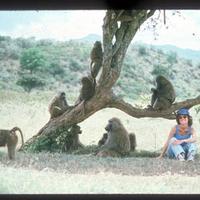
ROBERT: And back in the '70s, she moved to Kenya, in Africa, to a remote area, way out on the plains.
BARBARA SMUTS: Fairly open grassland.
ROBERT: And she tried to get friendly and then get access to a troop of ...
BARBARA SMUTS: Baboons.
ROBERT: Now how—what was the deal? Like, you would wake up, drive somewhere, get out of your van or whatever, walk in, like, at the break of day?
BARBARA SMUTS: Before the break of day. And then follow them around all day.
ROBERT: For how many days a week?
BARBARA SMUTS: Seven.
ROBERT: For weeks at a time, or a month at a time, or ...?
BARBARA SMUTS: Two years.
ROBERT: Two years.
BARBARA SMUTS: Yeah. This troupe hadn't been studied before, so they were afraid of people. But because the area was very open, it was possible to approach them from a distance.
ROBERT: She'd position herself, you know, like about 100 feet away. And then ...
BARBARA SMUTS: And day by day, I would kind of inch closer.
ROBERT: 80 feet away and then 50 feet away.
BARBARA SMUTS: And then as soon as they started running, I would stop moving toward them.
ROBERT: She says sometimes they would flash their teeth at her.
BARBARA SMUTS: Long, sharp canine teeth.
ROBERT: And then she'd edge off.
BARBARA SMUTS: Pretty scary.
ROBERT: And then slowly, she'd try again.
BARBARA SMUTS: I'd get a little bit closer.
ROBERT: 30 feet. 20 feet. Until finally, after a couple of months ...
BARBARA SMUTS: I got close enough so that I could see their faces. I could begin to recognize them as individuals, and they could recognize me. That's when things started to shift. It was like they realized that I was a social animal like them, and that we could negotiate the distance between us.
ROBERT: How does that work?
BARBARA SMUTS: I started by just talking to them, telling them that I wasn't a threat.
ROBERT: In English or in grunts?
BARBARA SMUTS: In English. Yeah, all mammals recognize that a fairly high-pitched voice is someone who's not threatening, as opposed to a very deep voice which scares them. So I would talk to them in a light tone of voice to reassure them. Finally, I got to the point where I could be just a few feet from them and nobody would even glance at me.
ROBERT: And what if one comes up to you and goes [snort snort]. Or whatever they do?
BARBARA SMUTS: Then I would think it was a warthog.
ROBERT: [laughs] What is a baboon? What does a baboon grunt sound like?
BARBARA SMUTS: [grunts]
ROBERT: Okay.
BARBARA SMUTS: They smack their lips in between grunts, the females.
ROBERT: So if they do that to you and they're getting closer, do you respond in kind, or what do you do?
BARBARA SMUTS: Yes, sometimes I would respond in kind with a grunt. [grunts] It's not polite if someone says something to you to just act like a rock.
ROBERT: Would that be an insult?
BARBARA SMUTS: Yes.
ROBERT: Oh, because you're supposed to say hello when I say hello.
BARBARA SMUTS: Right.
ROBERT: Like humans. But isn't this one of these rules of field biology? Aren't you supposed to act like you're not there and they'll act like you're not there?
BARBARA SMUTS: Yeah, but it doesn't really work that way. They're social animals and they know that you are.
ROBERT: So your solution was to become, as I figure it, you're like—you'd be trying to become a very shy baboon.
BARBARA SMUTS: Yeah. Shy and pretty boring.
ROBERT: And did that work? Did you become ...
BARBARA SMUTS: I did. I found myself very naturally sitting the way that many baboons do, which is they stick their legs out in front of them and they hold their toes. The longer I was with them, the more, well, completely automatic it became for me to be a shy baboon. I didn't have to think about it. I just was.
ROBERT: As this progresses, are you beginning to feel like you're a shy baboon?
BARBARA SMUTS: Yeah. I felt increasingly aware of my animal self. I mean, the scientist is doing the things the scientist needs to do. But I think I was kind of in this subuniverse, me and the baboons. I was going where they went and resting when they rested and walking when they walked.
ROBERT: One day, she says she saw a beautiful baby gazelle prancing by, and the baboons pounced on the animal, ripped it apart to eat it. And watching, Barbara admits that she salivated.
BARBARA SMUTS: Yeah, I did. I couldn't help it. And I am a vegetarian.
ROBERT: Oh!
BARBARA SMUTS: [laughs]
ROBERT: But she says the real transforming moment was she was out on the plains one day, and ...
BARBARA SMUTS: I got caught in this pouring rain and lost the baboons. So I headed downhill toward the lake because that was the way home. And when I got to the beach, it was still pouring, so I ducked into this hut. There were these little fishermen's huts on the beach that were empty, completely dark inside. And after I was in there for a minute or two, my eyes started adjusting to the dark. And first thing I noticed were these sort of lumpy shapes.
ROBERT: Oh!
BARBARA SMUTS: And then I realized that there were baboons in there.
ROBERT: Whoa!
BARBARA SMUTS: And as my vision got better, I could see about 15 or 20 members of my troop who had gone into the hut probably just before me. Had the same idea that I had. And I was quite touched that they were silent when I moved in there, and that nobody—you know, nobody said, "What are you doing in here? This is our hut." They were just silent. I think someone even shifted over slightly to make room for me. And we just sat there for about 15 minutes. Started to kind of steam up, you know, from their breath. And they smell like—kind of like grass and leaves, because that's what they've been eating. It's a nice smell.
ROBERT: Did you ever think for even a while—maybe in that hut was the moment. Do you ever think that you had done something close to some kind of trespass? Did you steal something here?
BARBARA SMUTS: No, no.
ROBERT: No, that was just ...
BARBARA SMUTS: You know, we are so used to this dividing line. There's humans on one side, and then there's all the other animals on the other side, and we don't meet up. But if you go back in evolutionary time, I mean, that line wasn't there. So rather than feeling like I was stealing something, I felt like I was retrieving something that was my heritage.
ROBERT: Hmm.
BARBARA SMUTS: It felt so completely natural to just be with them, to not be doing anything, to just be.
ROBERT: Barbara Smuts now spends her days in Ann Arbor, Michigan. She's a teacher there at the big university. And her African days are—well, they're now a couple of decades old, but what a tale.
JAD: Yeah. Speaking of tales, we are at the tail end of this little podcast. If you want any more information on this piece or anything you've ever heard on this program, Radiolab.org is the place. Jad Abumrad.
ROBERT: I'm Robert Krulwich.
JAD: Thanks for listening.
[ANSWERING MACHINE: Start of message.]
[LISTENER: Devin Lucero from Chico, California, and I'm a Radiolab listener. The Radiolab podcast is funded in part by the National Science Foundation and the Sloan Foundation.]
[ANSWERING MACHINE: End of message.]
-30-
Copyright © 2024 New York Public Radio. All rights reserved. Visit our website terms of use at www.wnyc.org for further information.
New York Public Radio transcripts are created on a rush deadline, often by contractors. This text may not be in its final form and may be updated or revised in the future. Accuracy and availability may vary. The authoritative record of programming is the audio record.