Feb 12, 2016
Transcript
[RADIOLAB INTRO]
ROBERT KRULWICH: I'm Robert Krulwich.
MOLLY WEBSTER: I'm Molly Webster.
ROBERT: This is Radiolab. We've decided to offer you guys a little treat. It's gonna be part prose, part musical in a hip hop sort of way, with some extremely cool guests.
MOLLY: Really?
ROBERT: Oh, I promise you. Yes. At the end of the show. And it all grows out of a tale we heard about a very small animal, which begins appropriately with a very small noise.
DAVID GOULSON: Yeah. So in days gone by, people tended to die at home. This is—go back a couple of hundred years before there were hospitals and so on.
ROBERT: This, by the way, is David Goulson.
DAVID GOULSON: \'m a professor of biology at the University of Sussex in the UK.
ROBERT: And he told this tale to producer Latif Nasser and I.
DAVID GOULSON: So you imagine that, you know, grandpa's ill and looks like he might die soon. [laughs] Sorry, I don't know why that's funny, but—and so he'd be lying in bed upstairs, and everyone would be—out of respect, would be very quiet. You know, they'd be creeping around the house. It was a time called the death watch. And when everyone was really quiet, they'd hear these faint drumming noises coming from the timbers of the house. I can try and do an impression of the noise, actually.
ROBERT: Yeah, I'd love to hear you.
DAVID GOULSON: May not work very well, but bear with me.
ROBERT: Yeah.
DAVID GOULSON: [tapping] Did you get that?
ROBERT: Yeah.
LATIF NASSER: Yeah.
DAVID GOULSON: So five or six identical beats. And legend has it that this was the devil drumming his fingers impatiently, waiting for the soul to depart the body so that he could claim it.
ROBERT: Ah!
DAVID GOULSON: But turns out, actually it's the mating call of a tiny little beetle. The deathwatch beetle. That's where it gets its name.
ROBERT: So Dave became a kind of a fan of these beetles.
DAVID GOULSON: Oh, yeah. It's a widespread species and ...
ROBERT: And in fact, he's got a house that's full of them.
DAVID GOULSON: It's pretty decrepit. It's slightly falling down, the roof leaks and whatever, but it's home to a whole host of these little beetles.
ROBERT: And in the quiet, he can hear them. So a while ago he found himself wondering, what's this noise really all about?
DAVID GOULSON: Which, you might not think would be a great mystery.
ROBERT: But what he discovered is it's all about love—or at least sex. So today, a story that reminds us how difficult, lonely, how hard the mating game can be.
MOLLY: Perfect Valentine's Day.
ROBERT: No, it'll get better. So we will begin at the beginning.
DAVID GOULSON: The life cycle. Yeah. So the female bee lays an egg on a piece of dead wood.
ROBERT: And Dave said he would watch them, and the moms would just drop their babies randomly, some here, some there, usually into a hole in a log or into a wood beam.
DAVID GOULSON: And it hatches into the little tiny white grub. So imagine this little thing, pitch black, you know, in its own little tunnel on its own. And it starts chewing. It chews away at the wood very, very slowly. And eventually about 10 or 15 years later ...
ROBERT: What, years? It's gonna chew for 10 to 15 years?
DAVID GOULSON: Yeah, for a decade or more. Poor things. And eventually, it reaches the magnificent size of about a quarter of an inch, at which point it pupates. So it turns into a little chrysalis. And a few months later the adult beetle hatches out of that.
ROBERT: And so finally it crawls out of the log and onto the surface.
LATIF: Is that the first time they see light?
DAVID GOULSON: Yeah. Yeah, that would be it.
ROBERT: Oh, wow!
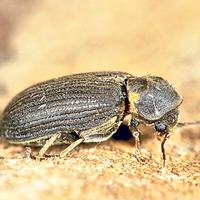
DAVID GOULSON: So it's only the adults that you ever really see. And they're possibly the most boring looking insects you could imagine.
LATIF: Really?
DAVID GOULSON: They're about a quarter of an inch long, bullet shaped, dull brown. They're really easily mistaken for mouse droppings, actually. And the adult only has really one job, and that's to mate.
ROBERT: So the male beetle ...
DAVID GOULSON: Has to find himself a female. So he's got his work cut out.
ROBERT: For one thing, as an adult, he doesn't eat.
DAVID GOULSON: He can't feed, so he's gonna starve to death in a couple of weeks or so.
ROBERT: On top of that, he's nearly blind.
DAVID GOULSON: Yeah. And that's where this strange drumming noise comes in. That's their way of finding each other in the usually rather dark places where they live.
ROBERT: That's your way of saying "Hello? Hello?"
DAVID GOULSON: Yeah. And they make it by drumming their head. So the male beetle, he kind of braces himself and then he whacks his head five, six times.
ROBERT: Oh, you say drumming the head, you mean banging the head?
DAVID GOULSON: Yeah, it's like headbutts the timber he's sitting on with his kind of forehead, if you like. So that's what makes the drumming noise. He's basically whacking his head against the wood.
ROBERT: So he comes out of his hole.
DAVID GOULSON: Just wanders about, and does his little drumming noise.
ROBERT: Now if a human happens to hear him ...
DAVID GOULSON: People these days, they tend to spray their houses with insecticides, and that's the end of the beetles.
ROBERT: Oh.
ROBERT: But let's assume ...
MOLLY: Yes, let's assume.
ROBERT: ... that he doesn't get fumigated, okay?
DAVID GOULSON: He just keeps wandering about, banging his head, and then he pauses for a second kind of listening to see if anyone replies. And if there's no reply, he wanders on.
ROBERT: Unfortunately, according to David ...
DAVID GOULSON: Deathwatch beetles are quite rare these days, so there is a distinct chance the poor male will never find a female.
LATIF: Oh, this just gets more and more depressing.
DAVID GOULSON: [laughs] Well they—sorry, I'm laughing again.
LATIF: [laughs] And can you tell the same story from the female's perspective? So she just sort of is—she just waits in silence for three weeks, and if no one comes she just ...
DAVID GOULSON: Keels over and dies. Yeah.
LATIF: Oh, God!
DAVID GOULSON: She wanders around a little bit, I suppose, in the hope that she might encounter a male, but that is all she does. Tedious life I'm afraid.
ROBERT: But let's imagine again for the sake of argument, that after the 15 years of chewing and no fumigations for them at all, let's then think, wow, they get really lucky!
DAVID GOULSON: He gets a reply.
ROBERT: They find each other.
DAVID GOULSON: She makes the noise immediately after she hears the cry of a male, and he then gets very excited because he may have been wandering about banging his head for days. And this little duet gets going. He starts to run around.
ROBERT: Banging his head over and over again.
DAVID GOULSON: You know, this is his moment. And eventually by a lot of trial and error—and occasionally they got it wrong and fell off the edge and were never seen again. But more often than not he would eventually find the female, and the males will immediately jump on top of her. And he then continues to drum his head, but this time he's not headbutting the timber, he's whacking her, which I mean, each to their own, you know? Presumably that works for a female deathwatch beetle. But because they're very short sighted, they will often jump on the wrong way round, and that's not so good because the females can actually control. He can't force them to mate. So he has to persuade her to cooperate, or else he's going nowhere.
ROBERT: Can humans tell if it's going well?
DAVID GOULSON: Well, so usually she carries on replying. So he's banging her in the back of the head, and she's then drumming her head on the wood underneath. And that's usually a good sign, that if she carries on banging her head on the timber, that means she's probably gonna mate with him within the next minute or two.
ROBERT: But Dave says when he has watched this happen, he's noticed that ...
DAVID GOULSON: Quite often, the females wouldn't mate, even though, you know, they'd maybe been sitting there for days waiting for a partner to come along. And then when one finally does and he finally gets to them, they're not interested. You know, it's not good enough.
ROBERT: I thought that they were—they only have three weeks.
LATIF: That is so shocking to me!
ROBERT: This is a very discerning lady, that she chooses death over an ugly mate.
DAVID GOULSON: Well, I guess she's not, actually. She's hoping that she'll get a better mate. There's another fish in the sea.
ROBERT: Another fish in the sea.
DAVID GOULSON: Hopefully. But I thought, well, what's the difference? Why are some males successful and some not? And it quickly became clear that the heavier the male, the more likely he was to be successful.
ROBERT: So is there some explanation for why?
DAVID GOULSON: So actually, these things, they produce quite staggering amounts of sperm, it turns out.
LATIF: Wait, what is staggering? What do you mean by staggering?
DAVID GOULSON: The average was 13 percent of his body weight.
ROBERT: 13 percent.
LATIF: What?
ROBERT: So if that were us, like, what would that be like?
DAVID GOULSON: We were talking about three or four gallons. So, you know, think about that from—it's best not to think about that too much, really. But ...
LATIF: Because that's just so gross.
DAVID GOULSON: It's slightly disturbing.
ROBERT: So the deep tragedy here would be to be a member of this species and to be born ...
LATIF: Scrawny.
ROBERT: Scrawny.
DAVID GOULSON: Yeah.
ROBERT: I mean, just out of curiosity, just how big are you?
DAVID GOULSON: I'm moderately skinny, so if there's a difference, I'd be in trouble. Anyway, so what I really wanted to know was were the females actually just weighing the males, or was it something that was correlated with being a big male? You know, maybe they were stronger or made a louder noise or something. And so the obvious way to try and find out was to artificially change the weight of the males.
LATIF: So make tiny fat suits for the ...
DAVID GOULSON: Well, exactly. Yeah. Not quite, but I wish this worked for people. It would be hilarious, but I don't think it does. So we have this stuff called Blue Tack in the UK. Do you have Blue Tack over there? I don't know.
LATIF: Like Sticky Tack?
DAVID GOULSON: Sticky Tack. I guess you use it to stick posters on the wall.
ROBERT: So Dave went to the store, bought some of this stuff, and then just bead it up into little bits.
DAVID GOULSON: And stuck them on the back of males to make them a little bit heavier.
ROBERT: And for the skinny males ...
DAVID GOULSON: It worked an absolute treat, these males, but I do feel slightly mean that those poor females obviously were getting a bit shortchanged, but hopefully they managed to produce some eggs anyway.
ROBERT: Because in the end, Dave finds these beetles, the males and the females, surprisingly charming. And after all, he does live with them. A lot of them.
DAVID GOULSON: They're still in my house. They're still chewing away at the beams. I've been—I'm torn. You know, part of me knows that if I don't spray them with some insecticide, then eventually the roof will start to collapse, but it's gonna take decades, and I kind of quite like having them there. So for the moment, they've been spared. And I kind of quite like listening to them tapping away in the springtime.
ROBERT: So you're sitting in bed at dawn or dusk, and you hear the quiet banging and you think ...
DAVID GOULSON: Yeah. Yeah. It's funny, isn't it, that people thought this was a sinister noise and actually it's all about love.
MOLLY: Thank you to Dave Goulson who wrote a book all about these bugs, A Buzz in the Meadow: A Natural History of a French Farm.
ROBERT: Oh, I didn't mention to you that it's a French farm. He has this little place in France that he goes to one month a year, and that's where he communes with his beetle friends.
MOLLY: And has one of the saddest months thinking about that.
ROBERT: Do you find it terribly sad?
MOLLY: I found it—it made me think that dating in New York was pretty easy.
ROBERT: [laughs] All right. For people who are feeling—if you're feeling sad, we want to end that problem right away. In the next part of this show, we're going to revisit this story in such a crazily new way for us. The guys from Hamilton, the hot Broadway show, I told some of them this story that you just heard, and they have decided to musicalize the tale. And they will do that right after this brief pause. But oh, before—while—during the pause, you know how raunchy this story is? Well, it only gets more so when it's in the musical tell. So you might want to ask your little ones to leave the room around now. And then you should by all means, stay for the after party.
[LISTENER: This is Melanie calling from Durham, North Carolina. Radiolab is supported in part by the Alfred P. Sloan foundation, enhancing public understanding of science and technology in the modern world. More information about Sloan at www.sloan.org.]
ROBERT: I'm Robert Krulwich.
MOLLY: I'm Molly Webster.
ROBERT: This is Act Two, in which I—you know, when I put together these—any story, as you know, I just wander around and tell it to every single person I know. So yeah, it could be strangers. So I was talking to a friend of mine who's in the theater, a guy named Tommy Kale. I'm talking to him and I'm saying, "I'm wondering what's going on in the minds of these little—assuming that they have minds, these little animals." Because it seems so unfair. 15 years of chewing and then this? So he said, "You know, we could be those beetles."
MOLLY: Wait, who's the 'we?'
ROBERT: The 'we' is an improvisational freestyle group called Freestyle Love Supreme. And it's—now this I should tell you. Tommy goes to Lin-Manuel Miranda.
MOLLY: Who's no joke.
ROBERT: Who is Hamilton in the hit musical Hamilton. And he writes, he says, "I'll be one of the beetles." And then they go to Utkarsh Ambudkar, who was in a movie called Pitch Perfect where he played a rapper.
MOLLY: Oh, yeah!
ROBERT: And by the way, this is all guys. This is like—you have to think of yourself as in an Elizabethan beetle situation.
MOLLY: This is Shakespearean deathwatch beetles.
ROBERT: That's right. All the lady parts will be played by males. So Lin's gonna be a woman, and Utkarsh is going to be the man. So here is the male beetle being the beetle that he hopes he can be.
UTKARSH AMBUDKAR: [rapping] Hey, ladies, I said the wait is over. Get ready for the beautiful beetle Casanova. He is I and I am him. The most masculine beetle by the name of Slim. Now evolution made me small so I could slip through the cracks. I'll be the first one to jump on a lady beetle's back. But it's hard out here, and I'm not playing. The human beings hear me, and then they get to spraying. They think that I'm the devil, so they get to fumigatin'. They don't understand that I'm only procreating. But I'm slimmer, so I'm a winner. I finally see the sun peep a shorty and I know that she the one. So I'm like, beetle baby doll, let's get involved. I want to give it to you all right here on this log. [singing] I've been chewing through that wood for my entire life, and it feels so good to finally find a wife. Yeah, I guarantee I'm your chosen, but can you remind me which end it goes in?
ROBERT: This is hard!
MOLLY: Yeah, it's hard out there for a beetle.
ROBERT: But for the female, played by Lin Miranda, I mean, she's gonna have her own agenda. She needs to find a guy. It has to be—she hopes it'll be the best guy. But I don't know.
LIN-MANUEL MIRANDA: [singing] Somebody's knocking. Could this be the beetle I've been waiting for? Somebody's knocking. Bae, Is this a mate worth waiting for? My mama told me to never settle. I always did as I was told. I'm looking for a hottie with a body full of sperm and deep down a heart of gold. But when you hear that knocking and it's a sound so rare, is the grass always green or is there a heavier beetle somewhere? Somebody's knocking. But I am a beetle worth waiting for. Somebody's knocking. I'm gonna wait for something more.
MOLLY: The power of the female.
ROBERT: And the sadness for the guy. But this is a Valentine's Day ...
MOLLY: [laughs] You never feel sad for the lady. What if she gets some lame dude and she's like, "Oh my God, I've waited 15 years for this, and I can't do it with you." And she has to move on and fall off the table.
ROBERT: Okay, okay. But now you know that Professor Goulson is our cupid here after a fashion.
MOLLY: Right. He's gonna save both of our sad souls.
ROBERT: Yes, with the sticky tack. So here is the—this is kind of a lame, validated card when I'm thinking about it. But here is our finish to our own Valentine's tale. A little Romeo and Julietish, actually.
UTKARSH AMBUDKAR: [singing] Against all odds, I'm gonna make you mine at the end of the day. Wait, I'm half blind. Where are you?
LIN-MANUEL MIRANDA: Fine.
UTKARSH AMBUDKAR: Oh, there you are. I've been chewing all my life long trying to put the work in. Beetle baby doll, don't let me die a virgin. I'm certain that love will burn like embers. I'll be the one and only love you remember. Keep banging your head on the timber. I agree it'd be easier with Tinder, but let me loose inside your caboose so I could give you some of my beetle juice.
LIN-MANUEL MIRANDA: Somebody's knocking.
UTKARSH AMBUDKAR: Okay, I know I was playing it cool before, but seriously, I got no clue what I'm doing. So if you could help me out, you'd be doing me a real solid.
LIN-MANUEL MIRANDA: You found your way to me.
UTKARSH AMBUDKAR: Little did she know. Before I beat it, the doctor helped me. I cheated. [laughs] Slim wins are good. I'm dead.
LIN-MANUEL MIRANDA: But what a way to go!
ROBERT: Okay, it is time, of course, for us to go. Thanks especially to Freestyle Love Supreme. And to Utkarsh Ambudkar, otherwise known as UTK. To Thomas Kahle and to Lin-Manuel Miranda.
MOLLY: And to our producers on this episode, Soren Wheeler and Simon Adler. Thank you. Thank you.
ROBERT: I'm Robert Krulwich.
MOLLY: I'm Molly Webster.
ROBERT: And happy Valentine's Day.
MOLLY: Happy Valentine's Day, Robert.
ROBERT: Yeah, you too. You too.
MOLLY: [laughs]
[ANSWERING MACHINE: Message one.]
[DAVID GOULSON: Hi, this is Dave Goulson leaving a message. This is the credits for the show. Radiolab is produced by Jad Abumrad, if that's pronounced correctly. Our staff includes: Simon Adler, Brenna Farrell, David Gabel, Dylan Keefe, Matt Kielty, Robert Krulwich, Andy Mills, Latif Nasser, Kelsey Padgett, Arianne Wack, Molly Webster, Soren Wheeler and Jamie York, with help from Alexandra Leigh Young, Tracie Hunte. It says here Tam. That must be Stephanie Tam. And Micah Loewinger. Our fact checkers are Eva Dasher and Michelle Harris. And I'm Dave Goulson. Good night.]
[ANSWERING MACHINE: End of message.]
-30-
Copyright © 2024 New York Public Radio. All rights reserved. Visit our website terms of use at www.wnyc.org for further information.
New York Public Radio transcripts are created on a rush deadline, often by contractors. This text may not be in its final form and may be updated or revised in the future. Accuracy and availability may vary. The authoritative record of programming is the audio record.