Nov 14, 2025
Transcript
[RADIOLAB INTRO]
LULU MILLER: I guess where I really want to begin is actually just because so much of this is about reality and different realities and inquiring about realities, I wonder where you stand on the many worlds interpretation, this idea of many worlds, parallel universes. What—what do you think about that?
QASEM WALEED: I think it's very interesting because for a person who lives this madness in Gaza, imagining that there is another world, another peaceful world that is away from all this madness, away from all this horror, where I have another version of me living peacefully, just living a life, is very intriguing. But scientifically speaking, I don't actually believe in it so much.
LULU: [laughs] You don't. Okay.
QASEM WALEED: Yeah. I don't believe in it.
LULU: This is Qasem Waleed, a 28-year-old physicist who has lived his whole life in Gaza. And over the last couple of years, as Israel has dropped bombs all around him, as he's lost friends and family, like many Palestinians, he's been posting videos and essays trying to show the world what's really going on. Only he has been doing it using quantum physics. And I wanted to understand why. So I called him up, and we talked many times over five months as more and more groups including the UN declared that Israel was committing genocide in Gaza, as ceasefires were called—and then broken.
LULU: And he told me the tale of how quantum physics entered his life, how it has helped him to survive the unthinkable chaos, and how that unthinkable chaos granted him access to perceive that confusing quantum state at the bottom of our physical world. If that makes no sense, I promise it will when Qasem explains it. I'm gonna pick up with our very first conversation, which we had back in July of 2025, when Israel's restrictions on aid had created mass starvation all around him in Gaza.
LULU: I wonder if you can just start by describing your reality right now.
QASEM WALEED: Okay, so today is July 29. Tuesday. And right now it's 6:16, Gaza time. I live, actually, in Khan Yunis, which is in the south of Gaza—the Gaza strip. I'm actually in a cafe which is in Al Mawasi area. Just a few people are here, but if I move outside there will be, like, a zillion people, because I'm right next to the—the tent camp.
LULU: When is the last time you ate? I know you had to cancel last week because you wrote that you'd spent three days looking for flour and hadn't found any.
QASEM WALEED: Exact—yeah. I think four days or three days ago, I was actually going to the Morag crossing. And unfortunately I couldn't take anything because there was, like, a zillion people, it was so packed. And we were being shot at, and I was just taking the floor, taking shelter. And there is no shelter. It's just open land, you know? I'm sorry to say that, but the only shelter you can take is the guy in front of you.
LULU: Oh!
QASEM WALEED: And luckily we got, like, some help from relatives and from friends, two kilos of flour. We can survive on them for—for the last two or three days.
LULU: What—what is that sound that I hear? Is that a plane?
QASEM WALEED: Yeah. This is actually a warplane. I think it's an F-16 or something. We hear this on a daily basis. And we actually can, right now, tell which kind of a bomb is going to hit the ground, if it's going to be a drone, if it's going to be a quad copter.
LULU: Are you—are you less safe by being here right now talking to me? Is this a risk?
QASEM WALEED: Well, you know, living in Gaza is a risk. Every place here. Whenever I go out from my tent I pray for myself. Whenever I enter any place I pray for myself, for my safety, for my family's safety, for everyone's safety. Just a couple of days ago, actually, they—they bombed the college right behind me, just about, like, 30 or 40 meters. So—but, you know, I don't have another choice, because I don't have access to the internet, so I have to go to cafes to get better access to the internet.
LULU: Okay.
QASEM WALEED: Which is not very good, actually. But, you know, this is what I've got in here. So yes.
LULU: So from the noise of that cafe, Qasem told me where his story with quantum physics began.
QASEM WALEED: Funny enough, the first time I really got intrigued by physics, it was due to the stars.
LULU: Huh!
QASEM WALEED: I don't want to say I was a romantic kid, but I was spending a lot of time on the rooftop just looking at the stars and the night sky. You know, Gaza isn't the best place that you can view, or observe the night sky from, because we have, I think, more than 90 percent air pollution, because of the density and the, you know, bombings from time to time.
QASEM WALEED: But I remember I was in the eighth grade. I was 14 years old. I remember what night it was. There was a heavy rain, and I think it was around midnight that—when the—the rain had stopped, I decided to go to the rooftop just to look at the stars. And the scene was absolutely magnificent, Lulu. I still remember the scene. It looked like pearls.
LULU: Pearls?
QASEM WALEED: Yeah, exactly. Pearls. But that night, I believe that some angel just sweeped up the whole sky and the view was like full HD. The first thing that my eyes was laid on was the three dots in the sky, which later on I found the name of them, which is called the Orion belt.
LULU: And Qasem would wonder about those twinkling pearls in the sky.
QASEM WALEED: What they are made of, why they are pulsing? You know, when you look at the stars they have these pulsing lights, on and off, if this was some sort of a language or something.
LULU: Like a morse code?
QASEM WALEED: Exactly.
LULU: Hmm.
LULU: And there was someone in his life he could take these questions to.
QASEM WALEED: My father, who was a genius engineer. He worked, actually, as the manager of the engineering unit of the Palestine Broadcasting Channel. My father was a very generous man. He actually gave a lot of free lectures to my neighbors and my relatives in mathematics and physics.
LULU: Oh, wow!
QASEM WALEED: And from time to time I was intrigued by the stuff he was saying and lecturing about. So I sat from time to time. Not every time. I'm not a geek or something. But, you know, I ...
LULU: [laughs] Hey, I don't know, man. You're writing about quantum mechanics, like, all the time. Are you sure you're not a geek?
QASEM WALEED: Yeah. No, I can assure you I'm not a geek. But yeah, you know, I was intrigued. It was out of curiosity, I wanted to—to listen to what he was saying. And I had to, like, slide in between the students he had, and to sit around and listen to what he said. And it was very beautiful, you know?
LULU: Hmm.
QASEM WALEED: He would romanticize even, you know, engineering, physics and stuff. He would compare, like, the electric current for love or something between a male and female and between spouses and stuff. He was a romantic guy, yeah.
LULU: Qasem says he thinks his dad wanted to be a poet.
QASEM WALEED: But, you know, being a poet or a writer wasn't something, like, plausible. My mother's uncle used to write poems insulting the Israeli occupation. And he was locked up in jails for months. And I don't think my father wanted to be in jail for something, so he was, like, writing diaries and stuff and keeping it for himself, not publishing it.
LULU: Qasem's father died in 2016 when Qasem was 19 years old.
QASEM WALEED: Maybe in another universe where my dad is alive, I could be, like, still learning from him. But in my world, I believe my father said to me so many times that if he were to choose a field to major in, he would choose physics. He was a brilliant engineer, but he was so interested in physics. That's how he actually inspired me to continue with the physics field.
LULU: Did you see it as honoring him, like, living the life he didn't get to do but you wanted to, to have access to those ideas and those classes?
QASEM WALEED: I—I believe my father wouldn't want me to be his second chance, because my father was very strict that I am my own story, you know?
LULU: That's beautiful.
QASEM WALEED: Everyone had—had his story from this life. He had his story with all the difficulties he had from the poverty that he actually took his family from, and he wanted me to decide what I want.
LULU: And what he wanted was to study physics. So he did, at the Islamic University of Gaza.
QASEM WALEED: I don't know. It was the most beautiful place in the whole Gaza strip. The campus was like a painting. It was all tree covered with trees, big trees. And maybe my—my best place and my favorite place in the university was the library, because, you know, the library has this panoramic window where you can see different sides of the campus. You can see the whole university from there. You can see the students interacting with each other. You can see professors and students circling around each other. Because, you know, there is many lectures actually happening outdoors. You can see, like, casually a professor would take a bunch of students and sit under a tree to—to teach them about something. It was a perfect scene for a student. It was the perfect place for a besieged student that is trapped in Gaza to study in, because you can feel the freedom there. And then that's when I stumbled into quantum mechanics.
LULU: He took a few classes his first years, but it was his junior year that he met the guy who would change the course of his life, Dr. Sufyan Tayeh, a renowned physics professor and president of the whole university.
LULU: What did Dr. Tayeh look like?
QASEM WALEED: Okay, he was a catch, if I can say that.
LULU: A catch?
QASEM WALEED: He was a catch. He was the most elegant person I have ever seen, you know?
LULU: Yeah.
QASEM WALEED: His suits were so, like, tidied up and clean. And the way he actually do his hair ...
LULU: How did he do his hair?
QASEM WALEED: He actually flipped it over, like, to the back, you know? And he has this silver hair all around his head. And he was so, like, elegant, you know?
LULU: Yeah.
QASEM WALEED: We don't have this type of professors much in Gaza. We just have the shirt and the pants and some sort of shoes. But he was so dressed up every day, so elegant, so polite, you know? He would never raise his voice. He was like—I don't know, like a walking book that smells nice, you know? Do you know—yeah, do you know these old books we have and they smell unique?
LULU: Yeah.
QASEM WALEED: He was like that. He was an old book that smells nice.
LULU: And this old book that smells nice, he opened the door to the quantum realm, this place where the particles that build our world, that build each and every one of us and every tree, and every wall, and every bomb, and every moon, are in this maddening, shifty state called superposition, where they are impossible to pin down. They are not in any one concrete place, but they are also not quite in multiple places at once. But they are also definitely not nowhere.
QASEM WALEED: I know this is a little messed up.
LULU: [laughs] It's really messed up!
QASEM WALEED: Yeah.
LULU: But, Dr. Tayeh explained, that's just how it goes and you can't fight it. And to add just one more messed-up layer to this whole superposition state, particles are only in it when you're not looking. As soon as you look at a particle, when you measure it, it collapses out of superposition, back down into one thing or the other.
LULU: [laughs] What?
QASEM WALEED: Richard Feynman, which is in my perspective, is the most brilliant physicist, like, ever been. Like, he's the GOAT of physics.
LULU: [laughs] He's the GOAT, yeah.
QASEM WALEED: Yeah. He was, like, so puzzled by it. And he said that if you think you understand quantum mechanics, you don't really understand it.
LULU: The point isn't to understand it, it's just to accept it, that the math and all the fancy experiments say that superposition is a fact of life. And Dr. Tayeh explained that this creates all these wild effects.
QASEM WALEED: Maybe one of the stories I remember: when he talked about an experiment where the physicists collided two protons together near the speed of light. And from the debris of the collision of the two protons, two photons have emerged, which was super-weird. It's like crashing two cars and a bicycle came out from this collision. You know?
LULU: [laughs] Okay. Yeah.
QASEM WALEED: It was—it was so bizarre.
LULU: And sitting in Dr. Tayeh's classroom, Qasem was hooked.
QASEM WALEED: He was so subtle, so poetic, if I can say that. He was—like, you know, he can, like, projectize the physics concepts into life.
LULU: If you had to pin, like, one thing that really grabbed you, which one would it be?
QASEM WALEED: Like, quantum tunneling. It's like, you know—you know the quantum tunneling?
LULU: Qasem explained to me that quantum tunneling is this real thing that happens when electrons can just—boop!—tunnel through a barrier that it doesn't seem like they should be able to, almost like teleportation.
LULU: Whoa!
QASEM WALEED: So what Dr. Tayeh was trying to establish there is that we can make our own version of tunneling, because here we are living our life here in Gaza as besieged people, besieged civilians. Like, if I want to move from Gaza to Egypt I can't. Why? Because there is crossings or borders that Israel has set. I can't break through that barrier.
QASEM WALEED: But we are also created from subatomic particles. So how about to imagine ourselves as electrons and go to the moon? Yeah, we're talking here emotionally, spiritually, not in actual sense. Then why not looking up, and looking up to the sky, looking up to the one beautiful thing that is available to us for free, you know? Because nothing is free in Gaza.
LULU: So Qasem began tunneling deeper and deeper into the quantum world, where he began to see a future for his life as a physicist.
LULU: What—what did you start to—like, what did you want to find out, or what did you start to sort of imagine your life as a physicist could look like?
QASEM WALEED: I think I would, like, go for a scholarship. It would be most likely France, the UK or the US. I'm more into astrophysics.
LULU: Oh, really?
QASEM WALEED: I always wanted to visit NASA, SpaceX to see the rockets, the Falcon and stuff, to have this involvement with it, to—to capture it from my naked eye, not just from the screen of my laptop or my mobile. It would be quite something, actually. And that is a life I imagined myself.
LULU: So you—okay, so you had these dreams of maybe, like, getting a scholarship and becoming an astrophysicist, and maybe going to NASA and looking through this telescope with your naked eye and seeing stars in huge detail. And—and then for you, when did you know that was changing, or that—that possibility was eclipsing for the moment?
QASEM WALEED: Oh, my God.
LULU: What? Are you okay?
QASEM WALEED: The—no, no, no. The—I don't know if you hear it.
LULU: Yeah.
QASEM WALEED: They started the generator all over again.
LULU: Oh, yeah. Yeah, yeah.
QASEM WALEED: You hear it?
LULU: I hear it.
QASEM WALEED: This is a really interesting question. I really—I want to answer it, but the—I don't know if you can hear my voice clearly, and I'm actually running out of battery.
LULU: Okay.
QASEM WALEED: My battery is up to 22 percent.
LULU: Okay. So maybe what—okay, so ...
QASEM WALEED: I'm so sorry.
LULU: No, not at all!
QASEM WALEED: I'm so sorry.
LULU: Not at all.
QASEM WALEED: I'm really—I'm really having fun. I'm really having a really good time with you.
LULU: Me too. I am, too.
QASEM WALEED: Yeah. I really don't want this to end.
LULU: Could we do—I don't know, could we do one more some day this week? Or is it too dangerous for you?
QASEM WALEED: No, no. It's not dangerous, I think. You know the situation. But I don't know. I don't think it would be dangerous. We can—we can do it tomorrow if you would like.
LULU: Yeah, I would love to do it. Can we do it tomorrow? Can we do it tomorrow?
QASEM WALEED: Of course. Yeah, yeah. Of course.
LULU: Okay.
QASEM WALEED: Tomorrow, same time.
LULU: October 7, 2023. shortly after sunrise.
QASEM WALEED: At first—I'll be honest with you—I thought that was thunder. You know, sometimes we get some thunders in autumns in Gaza and some drizzles, you know, from time to time in autumn. So I thought at first that that's a thunder sound. But then I went out to see what's going on and I saw, like, countless rocket launching. Every single area from Gaza is actually—has this—stripes of the smokes that the rocket left behind.
LULU: This was, of course, the Hamas attack that would kill over a thousand Israelis. And within hours, Israel would begin its counterattack, which at the time of this recording has killed over 69,000 Palestinians.
QASEM WALEED: You can ask every Palestinian in Gaza, and would tell you that from October 7, we—we knew that something unprecedented is coming, and something we have never lived before, even our ancestors.
LULU: Just days later, Israeli jets fly toward his university.
QASEM WALEED: All I see is—was a nebula of rubble, ash and dust, a thick nebula that covered the whole campus. It was nothing that I've seen before.
LULU: Two months later, Israeli tanks push into his neighborhood.
QASEM WALEED: We were in the middle of the street when the bombshell started to fall upon our heads. The resonance, the sound of it, the high pitched sound of the bombshell is still bouncing on and off between the walls of my—of my skull, you know? I still remember the sound. It was really, really loud.
LULU: Did you think you were gonna die that day? I mean, did you think that was it?
QASEM WALEED: I think yes, because the nearest bomb was actually 20 meters or 30 meters away from me, and I was, like, just startled, and just stopped and just waiting for my—my fate—my destiny, until my mother, who turned out to be braver than I—than I do.
LULU: Oh, really?
QASEM WALEED: Yeah, I swear. She pulled me from my back of the shirt—the back of the shirt, and just aggressively pulled me towards the wall. It's the mother instinct, you know?
LULU: Yeah.
QASEM WALEED: I can't remember much, actually, because it was all—all happening fast, you know? We just—once we saw people going south, we just followed the crowd. And people were, like, walking towards Rafah because it's southern Gaza. They were walking like drunks, swaying. Like, staggering like drunks, you know? They didn't know where to go.
LULU: What—what do you—what was that sway, do you think?
QASEM WALEED: Do you know the pendulum movement?
LULU: Yeah, pendulum?
QASEM WALEED: Pendulum, exactly. They were swaying like they didn't have the energy to walk, so they were swaying ...
LULU: Oh.
QASEM WALEED: ... because they didn't know where to go. They didn't know where the road would end. They didn't know where their feet will land.
LULU: Qasem and his family joined that procession of people flowing south.
QASEM WALEED: I actually hold under my arm one mattress. My brother hold the other. My other brothers were holding, you know, clothes and other luggage. And we took it on foot. It took us, actually, more than three hours that day to reach to the point where we saw all the people that are just sitting on the ground, didn't know what to do. Others were starting to build, like, makeshift tents and stuff. And I have never built a tent before. So it was the time for me to—to move into a new world.
LULU: Yeah.
QASEM WALEED: A new world of tents. And yeah, it's my world now, which I've been living in since that day.
LULU: At some point in all of the chaos, Qasem finds some internet, checks his phone, and sees a picture of Dr. Tayeh—brown eyes warm, silver hair flipped back.
QASEM WALEED: I saw this post, you know, honoring Dr. Tayeh, and announcing his killing. His house was—was bombed by an Israeli airstrike.
LULU: Oh. Wow.
QASEM WALEED: When Israel issued the massive displacement orders, the majority of people there took refuge in southern Gaza. And Dr. Sufyan Tayeh, amazingly—and I—I don't know what was going on with him, but he decided to go even further in the north, because I believe his family home is located in there.
LULU: Yeah.
QASEM WALEED: And he took refuge in there. I don't know if "took refuge" is the right choice of word, but that is where he was killed.
LULU: Yeah. When you heard that news, what did you feel? What did you think?
QASEM WALEED: I don't know. I stopped there, like, for one minute or two. I don't, like, express myself more, like, loudly or something. I keep it to myself. So I just, like, stopped and—like, holding my phone, and just stopped looking at the—at the post at the time. And I couldn't believe it, you know?
LULU: Then a month later, the Israeli government prevents Qasem's aunt, Samar, from traveling to Egypt for medical treatment—and she dies. And all the while in the outside world, the UN's International Court of Justice is convening and deciding not to call what's happening inside a genocide. And the US is continuing to send billions of dollars in bombs and other military aid to Israel. And in the spring of 2024, Qasem hits a kind of breaking point. Despite being a pretty private person, he begins publishing pieces describing his reality.
QASEM WALEED: To speak up, to speak loud and to scream at the world to take action.
LULU: He started with a poem about his aunt.
QASEM WALEED: I miss you. I miss spending time with you. The memories keep buzzing above your couch.
LULU: Then he wrote an elegy to Dr. Tayeh.
QASEM WALEED: Life feels different now that Israel has killed my professor. Knowledge feels trapped behind unopenable gates.
LULU: He wrote about bombed pharmacies and schools and life in a tent camp.
QASEM WALEED: Fires burn and choke. Garbage piles rot in the sun.
LULU: And in nearly every essay, as he describes his surroundings in excruciating detail, at some point he casts his light on the quantum world.
QASEM WALEED: Recently I have noticed that my movement is similar to the quantum harmonic oscillator, QHO. In the QHO, electrons can also use a kind of stairs. It's called the ladder operator, and it's how electrons move between energy states. When I imagine myself as an electron, it is not the stairs I'm climbing that are the creation operator, it is the water, because it creates the ability to move from a lower energy state to a higher energy state, from being more thirsty to less thirsty.
LULU: I mean, there's all this stuff that you write about so beautifully, but it is—it's—quantum is so hard to understand.
QASEM WALEED: Yes. Yes.
LULU: And, like, I see you posed with this frustrating circumstance, that you are in hell, and it seems like a lot of people, much of the outside world doesn't care, and isn't seeing it and isn't acting. And so you're trying to scream out by describing reality. But then you're using these quantum terms which are so hard. Do you worry that, like, that could confuse it or confuse people? Or have you ever found it fall short? I guess I just still wonder about the choice to bring in all the quantum stuff, which is—which is hard to understand.
QASEM WALEED: Well, I come from a scientific background. I have—I'm studying physics. I studied physics. And, you know, when you study something, you just live by it, and you see everything from its perspective. If you are a writer, you would see, like, people like stories or like poems. If you are a doctor you would see people like—I don't know, like cases or something. If you're an engineer, you start picturing people like machines or something. So that's me, a physicist, a student of physics trying to live a genocide. And my haven, my only haven that I can take refuge in is the world of physics.
QASEM WALEED: Because when you love a place, when you live in a place that you love, you feel comfortable. You feel like you own it and you feel like you can—you can be out of reach, like a whole universe that is just built for you. And surprisingly, you built it for yourself. I'm actually building this place on a daily basis, even inside my head. And I'm not talking here physically. It's actually—it's all in my head. But if I can escape inside my head and escape to the—inside the paths and the maze of physics and quantum physics in—in this as—say, like, seemingly arbitrary and randomness of physics, well so be it. I—I can't—if they can't offer me a safer place, if they can't offer me a refuge, if they can't offer me some comfort, then I'm lucky, I think, to have this, while two other millions in Gaza suffering on a daily basis. And I'm not saying that I'm not suffering, but I'm at least using something that I love as a safe zone, if I can say that.
LULU: In May of 2024, Israel invades Rafah.
QASEM WALEED: Which is now—lies not in rubble. It lies in sand.
LULU: You're saying it's beyond rubble?
QASEM WALEED: Exactly. It's beyond rubble right now. It's become a desert.
LULU: In July, one of his best friends is killed in an airstrike.
QASEM WALEED: Israel can come for the houses. They come for the hospitals. They come for the—the streets and for the schools. But I was, like, thinking, can they reach an atom? Like, if I was living inside an atom, if I'm picturing myself like an electron, is—that will be, like, my safe haven, my safe refuge where Israel or the Israeli army can't reach me?
LULU: And in December of 2024, he realizes something.
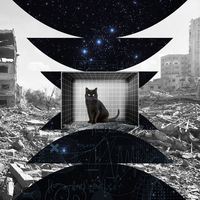
QASEM WALEED: Like Schrödinger's famous cat, I am trapped in a box. I have been stuck in this box since the beginning of Israel's genocidal war on my homeland, Gaza. So many people know I am inside it, but none can tell if I am alive or dead.
LULU: He writes about this realization in an essay using one of the most famous and maddening quantum thought puzzles, called Schrödinger's cat. I'm gonna Cliff's Note it just so we can get back to Qasem's writing. But basically, Schrödinger's cat is an imaginary experiment that this Austrian physicist, Irwin Schrödinger, dreamed up as a way of thinking about superposition, that shifty, annoying state that all subatomic particles are in when we're not measuring them. So it goes like this: There is a cat in a box with a radioactive atom that could decay and kill it. Or not. But you can't know whether the cat is dead or alive until you open the box. And since the fate of the cat is tied to the atom, which is itself in a superposition of being decayed and not decayed, does that mean that the cat, before we open the box, is both alive and dead?
LULU: And scientists love to fight about this. Schrödinger actually posed the whole thought puzzle as a kind of snub at quantum physics, saying, like, "Okay, there's no way that a cat can be both dead and alive at the same time, so we are misinterpreting what the math is saying about reality." But other scientists say, "No. You know, I think maybe the cat is both dead and alive." So back to Qasem's essay.
QASEM WALEED: Like Schrödinger's cat. I'm locked in a box that will eventually kill me. Luckily, I'm not dead—yet. But am I alive? I'm writing this, surely, but I can't leave the box. The only outcome available to me is death. So I am afraid I can't say that I'm alive either. Seemingly, my existence has now become identified by the superposition of the states of being simultaneously alive and dead. I am alive in a lifeless life, and all the possible paths ahead lead to my death.
LULU: Is what you're saying, like you're—you're trying to picture, not the moment of collapsing when the human measurement is involved, but what's going on in that box the whole time?
QASEM WALEED: Exactly. Exactly, because I'm living it. You know, I'm living it. So the whole point of it is that I feel sorry for that cat. I'm not talking here about the physicist in me, I'm talking about the human, about the Palestinian who is stuck in Gaza, not only for two years, because we—this is misleading. I'm stuck in Gaza for 20 years. I have been locked in this box for two decades. I can say for, I don't know, like, seven decades. I don't know how to describe it. I was satisfied, I was content with the box I used to have before this war.
LULU: Huh.
QASEM WALEED: You know? We were—like, so I don't know—adjusted to it. It wasn't perfect, but we adjusted to it.
LULU: Yeah.
QASEM WALEED: We—we know the schedules of electricity, we know the schedules of water, we know the schedules of everything, actually. We adjusted to it. We cope with the life. We just, like—you know, life goes on, and we have to go with it. But right now it's taking place in—in an ever-shrinking box. So I'm sympathizing with the cat, I'm empathizing with the cat, because the cat is me and I am the cat.
LULU: Hmm.
QASEM WALEED: Everything in life seems to follow a certain binary system, from electrons which spin in one direction or the other, to human beings, which can be either alive or dead. Still, this doesn't seem to apply to me, because whether I'm living or dead at any given moment is unknown. I'm no longer part of this binary of life and being, it seems. So what am I?
LULU: It's like you're saying you are experiencing superposition, this duality—you—that superposition concept is something that again, the brightest minds in science can't quite fathom. They just say, "Eh, just accept it." Like, we can't even—you can't imagine it. But you're also saying you are physically living superposition. So report back from superposition. What does it feel like to be so many states at once?
QASEM WALEED: It feels like if, God forbid, someone had pointed a gun to your head. Like, you're walking through your life with someone, like, walking behind you with a gun pointing to the back of your head. So yeah, that's what—what it feels like. It's horror. It's a horror. We are horrified on a daily basis. It's—if I go to grab food for my family, I'll be dead. If I want—if I went to the sea to catch some fish, an Israeli boat can target me. If I went back to my house to grab some wood an Israeli drone might kill me. If I went to the market, I might be hit. If I went to—if I was in the car, I might be hit. If I went anywhere in Gaza I might be—be hit and targeted and killed.
QASEM WALEED: So yeah, it's—I don't know. I can't describe it, actually. I'm so sorry. It's—it's insane. You know, it's insane. No one can live like this. Before the war, I was trying to see how we can get knowledge about certain dilemma or certain problem in the physics world, or mathematics, or any other field of science. But right now, I want to show the world the reality as is, you know? The reality as it is, to show them, like, "Here, look, this is the reality of Gaza. And you—you are the one who need to investigate this time." Do you feel that there's a shift in here?
LULU: It's like you went from scientist to objective study.
QASEM WALEED: Exactly. Exactly. I am the one who is inside the box. I am the one who is—who is trapped. I am the one who is stuck and can't—I'm out of reach and out of resources, and I'm out of knowledge and I'm out of everything that could help me to—to climb the ladder to open the box. It is not up to me. I tried. I failed. And it's your turn right now.
QASEM WALEED: In Schrödinger's cat experiment, everyone asked whether the cat was alive or dead, but none actually opened the box to see. If they had, the superposition would have collapsed and the cat would only be dead if they didn't open the box in time. We're not cats. Please open the box!
QASEM WALEED: Is my cell cutting off or anything? Is it ...?
LULU: No. You sound—you sound great. Can you hear me okay?
QASEM WALEED: Yes.
LULU: So we're recording this. It's October 16, 2025, six days after the ceasefire officially went into effect. And I guess, like, with the news of the ceasefire spreading, how has the box changed for you in the last week?
QASEM WALEED: It's the same box, but it gets only quieter. But it doesn't change that I'm still trapped inside this box. Like, from my own point of view, when I hear the ceasefire announcement, I thought one—the first question that popped into my mind was: what is my options right now? I don't have a house. I don't have a job. I don't have a life. I don't even have clothes to—to protect myself from winter.
LULU: Hmm.
QASEM WALEED: I actually tried to sneak out to my neighborhood a couple of days ago to save some clothes—winter clothes and some books from underneath the rubble. And I went with the first light of the morning because, you know, we take the whole distance between Al Mawasi into eastern Khan Yunus on foot. And we were shot at by a quad copter.
LULU: Really?
QASEM WALEED: Israeli drone, yeah.
LULU: And this was after the—the official ceasefire?
QASEM WALEED: Yes, that was a day after. It was actually the last Tuesday. So we're not going back to my house until further notice from the Israeli army, because it's a bit dangerous in there.
LULU: Okay.
QASEM WALEED: The ceasefire doesn't mean the genocide has stopped. It's just transformed to other shapes, other forms of it. And the only difference is just the rate of killing the civilians in Gaza. Because, you know, the rate of killing is decreasing, but it is the same tactics. It's the same reality.
LULU: Yeah.
QASEM WALEED: Yeah, we're trapped more than ever right now, and I don't think it will change any time soon. I don't just want to be—exist, like, inside this box. I—I do want to live.
LULU: Yeah.
QASEM WALEED: We always want something that is beyond our—that physical world, something metaphysical, something imaginative, something that is—can—can give us a reason.
LULU: Shortly after he said this, the call dropped.
LULU: Oh, I think I lost you.
QASEM WALEED: Hi again. I'm so sorry.
LULU: Hi.
QASEM WALEED: The internet, as usual, yeah.
LULU: No, no. Not at all. I was gonna say, how's the electricity grid? How's the internet? Is that still ...
QASEM WALEED: Well, you know, the sun is going down, actually. And so it's getting, like, slower and slower, my batteries.
LULU: Is it, like, every night you can't escape, you get cut off from the world?
QASEM WALEED: Yeah, because at night we don't have electricity anymore because it's all powered by the sun. But, you know, actually there is nothing more beautiful than the stars, especially, like, you don't have electricity at all because that is when you can see stars all clear. My first-ever question about stars is why they are pulsing, you know?
LULU: Yeah.
QASEM WALEED: I learned about it, like, many years later, why the pulsing happens. It was always because of the—our atmosphere, because of how the—the wind changes its direction through the layers of our atmosphere. It had nothing to do with the nature of the star itself.
LULU: Oh, interesting!
QASEM WALEED: The more I—I learned about that, you know, it's always like—it's not a toxic relationship. It's always like when I know—because, you know, when—in a relationship, when you know more about your partner, you—you start having some sort of a problem. But this is ...
LULU: It happens! You're so right.
QASEM WALEED: Yeah.
LULU: I would think sometimes knowledge can extinguish magic.
QASEM WALEED: Exact—exactly. It's not the same with the stars, because the more I know about them the more I fell in love with them, you know? Me with the stars is more of a feeling, an everlasting good feeling, that it actually makes me feel—feel good, even, about myself.
LULU: Hmm. Do you—can you see any stars right now?
QASEM WALEED: I can walk outside. Just give me a second.
LULU: Okay.
QASEM WALEED: So I'm actually sitting outside right now, but I can't recognize any patterns, unfortunately. But I know for sure that the Orion belt would be on the southern side of the—of the sky right now.
LULU: But you can't—you can't see them?
QASEM WALEED: You know, yeah, because Gaza would be—this war alone produced more greenhouse gases. I'm—I'm trying really hard.
LULU: Yeah.
QASEM WALEED: I'm so sorry, but I can't recognize any pattern. It—it seems, like, foggy ...
LULU: Yeah.
QASEM WALEED: ... up there.
LULU: This episode was produced by Jessica Yung. It was edited by Alex Neason, fact-checking by Emily Krieger. One little update: as we were getting this ready, the Nobel Prize in physics was announced for 2025, and it went to scientists for their work on quantum tunneling. They had done experiments which took it from the quantum world to the classical world, to our world. Meaning not just tiny particles, but big groups of particles can tunnel, can make it through barriers that it doesn't seem like they should be able to.
LULU: We had a ton of editorial support on this one, so big thanks to everyone who weighed in: Katya Rogers, Sarah Qari, Karim Kattan, Soren Wheeler, Pat Walters and Allan Adams. Also, if you'd like to read Qasem's whole essay, it's called "I Am Stuck in a Box Like Schrödinger's in Gaza." And it was published on Al Jazeera, December 19, 2024. There are also links to more of his work in the show notes here.
LULU: And finally, if you just have not had enough quantum physics for your day, our producer Jessica Yung had a wonderful conversation with the physicist Allen Adams at MIT to sort of help us understand quantum physics as best we could. It's really great. It goes into how there's, like, actually quantum stuff going on in our bodies and our proteins. And you can listen to that if you become a member of The Lab, which is a way that you can support Radiolab by heading on over to Radiolab.org/join. Many, many thanks for listening. Catch you next week.
[LISTENER: Hi, I'm Basif Qari, and I'm from Somerset, New Jersey. And here are the staff credits. Radiolab is hosted by Lulu Miller and Latif Nasser. Soren Wheeler is our executive editor. Sarah Sandbach is our executive director. Our managing editor is Pat Walters. Dylan Keefe is our director of sound design. Our staff includes: Simon Adler, Jeremy Bloom, W. Harry Fortuna, David Gebel, Maria Paz Gutiérrez, Sindhu Gnanasambandan, Matt Kielty, Mona Madgavkar, Annie McEwen, Alex Neason, Sarah Qari, Anisa Vietze, Arianne Wack, Molly Webster and Jessica Yung. With help from Rebecca Rand. Our fact-checkers are Diane Kelly, Emily Krieger, Anna Pujol-Mazini and Natalie Middleton.]
[LISTENER: Hi, I'm Maddie and I'm from Frederick, Maryland. Leadership support for Radiolab's science programming is provided by the Simons Foundation and the John Templeton Foundation. Foundational support for Radiolab was provided by the Alfred P. Sloan Foundation.]
-30-
Copyright © 2025 New York Public Radio. All rights reserved. Visit our website terms of use at www.wnyc.org for further information.
New York Public Radio transcripts are created on a rush deadline, often by contractors. This text may not be in its final form and may be updated or revised in the future. Accuracy and availability may vary. The authoritative record of programming is the audio record.