Jul 17, 2014
Transcript
JAD ABUMRAD: I'm Jad Abumrad.
ROBERT KRULWICH: I'm Robert Krulwich.
JAD: This is Radiolab. And this hour?
ROBERT: Well, the honeymoon's over.
JAD: [laughs] Galapagos.
ROBERT: This is the place where Darwin began to develop his theory of evolution.
JAD: And it's the place 170 years or maybe 180 years later where our producer Tim Howard landed, wearing fishnets and a Bad Brains t-shirt to find a very different landscape than what Darwin saw.
ROBERT: And we just told you a story about how far humans are willing to go to protect something.
TIM: This next part, it's about how far we're willing to go to get something back that we've already lost. To sort of restore a place and a creature to its quote "Wild state." This story unfolds on one of Galapagos's most northern islands, where they also had to get rid of some goats. It's called Pinta.
JAMES GIBBS: Yeah. Pinta is a very special place.
TIM: This is James Gibbs.
JAMES GIBBS: Professor of conservation biology at the State University of New York. It's one of those islands, it's not part of any tourist visitation site.
TIM: So there are no people there.
JAMES GIBBS: And when you set foot first on Pinta, you immediately sense sheer abundance. All the insect life, all the birds.
TIM: The problem is on Pinta, things were spinning out of control. The vegetation was growing wild, the forest was getting overgrown with the wrong kind of plants, and the whole ecosystem was just teetering out of balance. And one of the reasons for this, according to Linda Cayot, is that ...
LINDA CAYOT: We had an island with no tortoises.
TIM: Because tortoises are sort of like the lawnmowers.
LINDA CAYOT: You know, they plow down vegetation, disperse seeds.
TIM: But for centuries had been hunted by those whalers. And in about 1906, the Pinta tortoise went extinct.
JAD: 1906!
TIM: Yeah, a little over a hundred years ago. They don't know the exact date. But then, one evening in March of 1972 ...
PETER C. H. PRITCHARD: Yes.
TIM: ... this fellow ...
PETER C. H. PRITCHARD: Peter C. H. Pritchard.
TIM: ... he's a well-known tortoise researcher. He was on Santa Cruz Island having dinner with some friends.
PETER C. H. PRITCHARD: And we got on to chatting about tortoises.
TIM: And one of the people he's eating with says, "Hey, I was recently on Pinta Island collecting snails and I saw this ..."
PETER C. H. PRITCHARD: Tortoise. And I thought, "Do you know what you have done?" There have been no tortoises there for a hundred years.
TIM: He and some national park rangers race out to Pinta. And there it was.
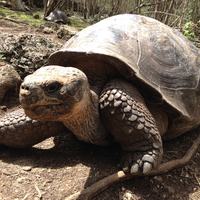
PETER C. H. PRITCHARD: This beautiful tortoise.
TIM: One male tortoise, maybe 50 years old, they weren't sure. They'd eventually name him ...
PETER C. H. PRITCHARD: George.
TIM: Lonesome George. But at the time, the immediate question was ...
PETER C. H. PRITCHARD: Are there any more?
TIM: Because if they could find a female for George, then they could, you know, maybe de-extinct the species.
PETER C. H. PRITCHARD: So they poked around in the areas where we got the one, and I found a shell of a female.
JAD: Hey!
PETER C. H. PRITCHARD: Dead animal.
JAD: Oh.
TIM: How had—how had this female tortoise died?
PETER C. H. PRITCHARD: Someone chopped it in half.
TIM: No!
PETER C. H. PRITCHARD: You could see the marks where it was just chopped up. I felt violent. I wanted to borrow someone's gun and go and kill the person.
JAMES GIBBS: Everyone held out hopes for just finding more tortoises.
TIM: James says they kept going back, combing the island.
JAMES GIBBS: With highly trained tortoise-sniffing dogs.
TIM: But in the end, there's just George.
JAMES GIBBS: And then shifted the focus on now what do we do?
LINDA CAYOT: We then went to Wolf Volcano.
TIM: Island next door.
LINDA CAYOT: And collected two females.
TIM: Two females that sort of looked like George, but weren't quite the same species.
LINDA CAYOT: And we put them with George to see if we could get him to breed. He never did.
TIM: Wasn't interested. So they thought ...
LINDA CAYOT: Hmm.
TIM: ... maybe he needs a Pinta lady. Now of course, there are no female tortoises on Pinta, but they thought, you know, maybe a zoo somewhere or private collection has one, because you really never know. So they called around, offered huge cash rewards. People sent in dozens of tortoises, but Linda took one look at them and was like ...
LINDA CAYOT: No. No. No. No.
TIM: They weren't pintas. So then they thought, "We've got to take matters into our own hands."
LINDA CAYOT: Basically, what you do is you sit at the back of the tortoise, and first you have to get to where they'll allow you to touch them.
TIM: Hmm.
LINDA CAYOT: And eventually you start, you know, fondling their—their legs and tails, and hoping to get them to ejaculate. And had a volunteer working with me. Her name was Fava Grigione. She worked with him every other day or so for a few months, and was never successful.
JAMES GIBBS: We were really starting to get kind of desperate about options.
TIM: And James says in a way it was a paradox because, on the one hand, awesome, we have an actual living Pinta Island tortoise, but on the other hand, he might have actually been like the worst possible candidate for last of his kind.
JAMES GIBBS: He seemed to really like to keep to himself.
LINDA CAYOT: He never really liked other tortoises much. He didn't seem to like humans.
TIM: And maybe that's why he survived. He wasn't curious. James says a lot of tortoises ...
JAMES GIBBS: They hear your footsteps, they raise their heads, they come out to see what's going on.
TIM: And then they get whacked.
JAMES GIBBS: Yeah.
TIM: In any case, for about 40 years, scientists tried everything humanly possible to get Lonesome George to mate with another tortoise so they could resurrect the species and bring Pinta Island back to its original state. Nothing worked until one day in July of 2008, George turns to the two female tortoises that he had been ignoring for years and he says ...
["Hello, beautiful and beautiful."]
TIM: And inexplicably, he just suddenly decides to mate with both of them. They each lay eggs.
JAMES GIBBS: Two clutches were ultimately laid in his corral.
TIM: And the scientists are like ...
JAMES GIBBS: George got our hopes up dramatically. But they ultimately were infertile.
JAD: Mother [bleep]!
JOSH DONLAN: In mid-'80s, they were having a meeting about this.
TIM: That's conservationist Josh Donlan again.
JOSH DONLAN: Whole bunch of herpetologists were out there and some island conservationists, and they're talking about what to do with Pinta, and they can't get Lonesome George to reproduce, which they were hoping to do because then they could build a Pinta population and put it on Pinta.
TIM: And he says that as a meeting wore on, it got tense.
JOSH DONLAN: Oh, for sure.
TIM: In fact, one guy I spoke with ...
HARRY GREENE: Harry Greene. I'm a professor of ecology and evolutionary biology at Cornell University.
TIM: ... said that at this meeting, there was one guy who just couldn't take it.
HARRY GREENE: All I remember is him just fuming. He sat there getting more and more and more frustrated, and finally he just blurted out, "Shoot that [bleep] tortoise and quit wasting our time."
TIM: [laughs]
TIM: Because in his view, this single individual was holding up this huge conservation opportunity.
HARRY GREENE: And of course, the shock was—there was a wave went around the room when he said that. I recall seeing sort of a second wave as the Spanish translation passed around the room.
TIM: And really, what that guy was specifically saying was, "Don't be precious."
JOSH DONLAN: A tortoise is a tortoise is a tortoise. Let's just take some tortoises ...
TIM: From a nearby island.
JOSH DONLAN: ... and put them back on Pinta.
TIM: But there's a much bigger question here ...
JOSH DONLAN: That goes way beyond Galapagos.
TIM: ... which is basically like, what is the right way to protect nature now?
JOSH DONLAN: People are right now throwing beers at each other around what is the right strategy.
TIM: Josh says that there are basically two camps right now. On the one side, you've got this classic, like what you might call the Eden approach.
JOSH DONLAN: Conservation biology, its foundation is this idea of pristine wilderness.
LINDA CAYOT: From the very beginning, I think all of us—well, I can't speak for other people, but you always have this idea of wanting to get it back to some kind of prehuman condition.
TIM: "Prehuman" being the operative word. And if you think about it, we all have this. We all have this picture of what we want to bring it all back to. You know, it might be like the plains just covered with buffalo, or maybe the Serengeti desert with lions and elephants or maybe it's 10,000 hammerhead sharks. But whatever the scene is, it just doesn't have any people.
JAD: But is carrying that idea, those pictures in your head, even, like, useful anymore? It's like ...
TIM: So cynical!
JAD: No! But it just seems so unrealistic.
JOSH DONLAN: Right? But I mean, in the bigger picture, you can make the argument that humans now affect every square meter of the Earth.
HOLLY DOREMUS: There's no place, no matter how remote we get. You can go to the North Pole, it's been affected by human activity. You can go—I don't know, the depths of the impenetrable jungle. It's been affected by human activity.
TIM: That's Holly Doremus. She's an environmental law professor at the Berkeley School of Law in California.
HOLLY DOREMUS: We're radically remaking the world, and the question is what's our responsibility?
TIM: And this brings us to our second school of thought, which in its most extreme version goes something like this:
JOSH DONLAN: We're God. We might as well get good at it. And we're going to have to create these ecosystems based on our best science.
TIM: And you could argue we're gonna have to get a whole lot better at making some very, very difficult decisions.
HOLLY DOREMUS: Climate change seems to mean that a lot of species are pretty much doomed. 30 percent, 40 percent, 50 percent of the species now on the planet, in a few decades may be disappearing. This is what I think is really the tough question now, is if we concede that we can't any longer save all the species, then does that put us in the situation of having to decide which ones we'll save and which ones we won't? And do we have any basis for making those kinds of decisions?
ROBERT: Hmm. So you saying that the quote, "Let's go back to when it was good. Let's go back to a better time," that's just silly.
HOLLY DOREMUS: I didn't say it was silly.
ROBERT: Okay, what did you—yeah.
HOLLY DOREMUS: I said it was impossible.
ROBERT: [laughs]
HOLLY DOREMUS: Things might not be silly, they might not be stupid ideas, but we still might not be able to do them.
TIM: Okay, so here's a wood plaque that says, "Lonesome George is the last survivor of the dynasty of land tortoises from Pinta Island.
TIM: And, in fact, in 2012, after decades of trying to get him to breed, Lonesome George dies.
TIM: R.I.P. 24th of June, 2012.
TIM: And the Pinta tortoise went extinct.
JAD: So damn. Case in point, I guess. No going back.
TIM: Yeah. And that's what I thought. But then I spoke with this woman ...
GISELLA CACCONE: Hello?
TIM: Hello. Gisella, do you hear me?
GISELLA CACCONE: Yes, I do.
TIM: ... who kind of scrambled everything up for me.
TIM: Can I get you to introduce yourself?
GISELLA CACCONE: Yes, my name is Gisella Caccone. I am a senior research scientist at Yale University.
TIM: And Giselle has come up with kind of a radical idea.
GISELLA CACCONE: I call it the Phoenix Project. [laughs]
TIM: Here's the backstory: in the mid-'90s ...
GISELLA CACCONE: We started in '94.
TIM: ... Gisella and some folks from the Galapagos National Park, they began taking a census of all the tortoises in the Galapagos.
GISELLA CACCONE: Every population of tortoises on all the islands.
TIM: They were gonna do this big population study, so they went island by island, took a little bit of blood from all these different tortoises, did a genetic analysis ...
GISELLA CACCONE: And hoopla!
TIM: Found something they never expected: a group of tortoises not on Pinta that had a lot of Pinta DNA.
GISELLA CACCONE: I can remember very clearly that moment. It was very, very exciting. It's like, "Yes, look at this!"
JAD: Wait, you're saying this Pinta DNA was on another island?
TIM: Yeah.
JAD: Not on Pinta.
TIM: No.
JAD: Well, how would that happen?
GISELLA CACCONE: We don't think it was natural.
TIM: Gisella thinks it might have been the whalers.
GISELLA CACCONE: Either the whalers or the pirates.
TIM: You know, because like we talked about, in the 1700-1800s, these whalers would come along, grab a bunch of tortoises, put them on the ship, and then they would hunt for whales.
["Thar she blows!"]
TIM: And sometimes ...
GISELLA CACCONE: When they were done, and if the ship was filled with whale products ...
["There's no room down here!"]
TIM: ... they'd throw a few extra tortoises overboard, say a few from ...
GISELLA CACCONE: Pinta.
TIM: Maybe those Pinta tortoises swam with the currents to that nearby island, set up a little expat community and started breeding with the locals.
GISELLA CACCONE: That's our working hypothesis.
TIM: Which brings us to her idea.
GISELLA CACCONE: You know, on average, 50 percent of your genome comes from your mom and 50 percent from your dad. But it's an average.
TIM: So Gisella thought just by chance, some of these tortoises are gonna have a little bit more Pinta DNA from their Pinta ancestors than others.
GISELLA CACCONE: Yes.
TIM: So what if we took those tortoises and bred them together?
GISELLA CACCONE: Select them for the next generation, so you can give a push to this process.
TIM: She says if we keep doing that, taking the babies with the most Pinta DNA and breeding them together, slowly, surely ...
GISELLA CACCONE: In four generations, you could have 90 percent of the Pinta genome restored.
TIM: Really?
GISELLA CACCONE: Yeah. But that's four generations of tortoises, not rats, which means at least 100 years.
TIM: But in the meantime, the vegetation on Pinta is growing out of control.
GISELLA CACCONE: From an ecological point of view, Pinta can't wait.
TIM: So in 2009, they come up with a stopgap. They take 39 tortoises raised in captivity, and they use them as placeholders. They sterilize them and put them on Pinta.
ROBERT: Really?
JAD: What?
TIM: Yeah.
ROBERT: Well, these are very purist sort of visions they've got.
TIM: Yeah.
JAD: They sterilize them.
TIM: 39 of them.
JAD: So they're just basically the lawnmowers. They're not actually ...
TIM: Exactly. and they put them on Pinta, and they're just chomping away right now. They're living out their lives really happily on Pinta, you know, until the originals are ready. Now Linda says in the end you don't actually need to do the full aggressive four-generation breeding thing. You can just take the best Pinta-ish tortoises you find and put those on Pinta.
LINDA CAYOT: And, you know, over the next 200,000 years, they will evolve into a Pinta tortoise. And it could be a bit different than the past Pinta tortoise, because evolution and mutation and all that doesn't occur the same. But eventually, nature's gonna take over and they will evolve into Pinta tortoises.
TIM: Is this the way that everybody who works on the tortoises thinks about it—this kind of deep time?
LINDA CAYOT: [laughs] I don't know. I'm not sure many other people think about that.
TIM: Just walked past a newspaper that says "72 hours left in the electoral campaign." And the flags are still flying everywhere.
ROBERT: We'll be back in less than 200,000 years.
JAD: Yeah, but we will be different when we come back.
ROBERT: Yeah, we will.
JAD: Stay tuned.
[LISTENER: Hi, this is Emily calling from rainy Vancouver, Washington. Radiolab is supported in part by the National Science Foundation and by the Alfred P. Sloan Foundation, enhancing public understanding of science and technology in the modern world. More information about Sloan at www.sloan.org.]
-30-
Copyright © 2023 New York Public Radio. All rights reserved. Visit our website terms of use at www.wnyc.org for further information.
New York Public Radio transcripts are created on a rush deadline, often by contractors. This text may not be in its final form and may be updated or revised in the future. Accuracy and availability may vary. The authoritative record of programming is the audio record.