Mar 6, 2026
Transcript
[RADIOLAB INTRO]
MOLLY WEBSTER: Am I recording? I'm recording.
SOREN WHEELER: Does your mic have fancy green lights on it?
MOLLY: Does yours not?
SOREN: No.
MOLLY: It, like, tells me how loud it is. And it also—and I can also mute it. Can you hear me? You can't hear me anymore.
SOREN: No, I can still.
MOLLY: Oh, you can?
SOREN: Yeah.
MOLLY: Wait, what does that button mean then? Hmm!
SOREN: Button. Button
MOLLY: [laughs]
MOLLY: I'm Molly Webster. This is Radiolab.
SOREN: Button? Button.
MOLLY: Um, okay. Well ...
MOLLY: And today, I am joined by our executive editor ...
SOREN: Button.
MOLLY: ... Soren Wheeler.
SOREN: What are we doing?
MOLLY: Why are you here? Well, you're here because I'm gonna take you on a walk.
SOREN: Oh! You're gonna take me on a walk? Where?
MENNO SCHILTHUIZEN: In a lowland area along the Kinabatangan River.
MOLLY: We're gonna follow this guy, Menno.
MENNO SCHILTHUIZEN: Menno Schilthuizen.
MOLLY: He's an evolutionary biologist.
SOREN: Seems like a nice guy to go on a walk with.
MOLLY: [laughs] Menno's going to take us deep into Borneo.
MENNO SCHILTHUIZEN: It's tropical, humid limestone forest, so it's—it's really wet.
MOLLY: There's lichens, there's ferns.
MENNO SCHILTHUIZEN: Orchids and vines and climbers.
MOLLY: And he is looking for something.
SOREN: Okay.
MOLLY: And actually ...
MOLLY: Bup bup bup bup.
MOLLY: ... I also went on a walk to look for this something.
MOLLY: Whew!
MOLLY: My walk was not in Borneo, it was in Brooklyn.
MOLLY: [sneezes]
MOLLY: In February. So less orchid.
MOLLY: Dog poop.
MOLLY: More ...
MOLLY: Cigarettes.
MOLLY: ... trash.
MOLLY: There's a pigeon.
SOREN: So this is something that you can find in both Borneo and Brooklyn?
MOLLY: Yes. In Borneo it's down by the riverbanks.
MENNO SCHILTHUIZEN: And the limestone cliffs.
MOLLY: In Brooklyn ...
MOLLY: Oh no, I'm right here.
MOLLY: ... you just make your way ...
MOLLY: ... through one single door.
MOLLY: ... to a store.
MOLLY: Whew!
MOLLY: And then right there, there is a glass tank.
MOLLY: I'm pressing my face up against the glass.
MENNO SCHILTHUIZEN: I really put my face to the surface of the rock.
MOLLY: [gasps]
MENNO SCHILTHUIZEN: And then ...
MOLLY: Oh, wait!
MENNO SCHILTHUIZEN: Sort of glistening in the sun.
MOLLY: Oh my goodness!
MENNO SCHILTHUIZEN: I see these miniature ...
MOLLY: ... tiny, tiny ...
MENNO SCHILTHUIZEN: ... snails.
SOREN: Snails?
MENNO SCHILTHUIZEN: Mm-hmm.
MOLLY: It's got a little brown shell with whorls.
SOREN: Is the thing that we went on a walk to see.
MENNO SCHILTHUIZEN: Right.
MOLLY: It's got two little antennas. And I just can't imagine a penis coming out of that face.
SOREN: Oh! Wait, what? [laughs] That—there's a penis in the snail's face?
MOLLY: [laughs] So it turns out that penis in the face ...
SOREN: Oh my God! [laughs]
MOLLY: ... is actually, like, maybe one of the least strange things about snails.
SOREN: What?
MOLLY: Soren, you look at snails and you think, like ...
SOREN: I don't think anything. I have never thought ...
MOLLY: Okay, fine. You don't even think about snails.
SOREN: Yeah.
MOLLY: And I'm here to tell you that there is so much to see when you look at a snail.
SOREN: Okay.
MOLLY: Including a sex life that I don't think any of us saw coming. And so that's what—that's what we're gonna do today. We're gonna do snails. Or they're gonna do each other, and we're just gonna watch.
SOREN: [laughs] In! I'm in!
MOLLY: Okay, and ...
MENNO SCHILTHUIZEN: Oh, dear.
MOLLY: ... our guy Menno ...
MENNO SCHILTHUIZEN: [laughs]
MOLLY: ... is gonna be our guide.
MENNO SCHILTHUIZEN: Exactly.
MOLLY: So let's go.
MENNO SCHILTHUIZEN: Okay. Well, to begin with, I wasn't originally interested in snails. I mean, as a schoolboy, I was mostly interested in insects and birds. But you can study things in snails that you cannot study in insects, and that often has to do with the fact that they move so slowly. So you can see ...
MOLLY: [laughs] You can catch 'em?
MENNO SCHILTHUIZEN: You can catch them, you can—you can mark them. So I've—I've put numbers on snail shells, and found them back a year later, or sometimes two years later, sitting on the same tree ...
MOLLY: Really?
MENNO SCHILTHUIZEN: ... that they were sitting on when I marked them.
MOLLY: No way, that's cute!
MENNO SCHILTHUIZEN: You know, people do that with insects, too, but the chance of finding them back is much smaller than with snails who mostly sit where you left them. So—so they call this the—the rate of dispersal, so that's basically the average distance between where an animal is born and the place where it has its first reproduction.
MOLLY: Okay.
MENNO SCHILTHUIZEN: And in snails, that's usually between one and five meters.
MOLLY: Oh, really? That's not—that's not very far at all.
MENNO SCHILTHUIZEN: It's not very far at all. And the consequence of that is that you—and that's really what got me hooked on snails is that you can see evolutionary patterns on a human scale, which normally you would need entire continents for. So in Crete, where I did my PhD, I would—I would walk through the—through the mountains, and with every step I would see subtle changes in the way the snail shells looked. So if you cover a few kilometers, you can see snail shells around you sitting on the rocks, changing from smooth to ribbed and from large to small. So you basically have walked through evolution.
MOLLY: So when he's taking this walk, there's, like, a giant cliff of rock. And in one tiny patch, there are a species of tiny snail. And one day, some of those individuals wander over to a very nearby patch of rock, and then they settle there. And evolution acts on them, and then some of them leave and go to another nearby patch of rock. And so basically you can walk patch to patch to patch and see how evolution has shaped these snails.
SOREN: Well, I'm fascinated by the idea that you can walk along this. But I'm like, yeah, what do you—what do you see when you go? A slightly different shell, or a different antenna? Slimier or less slimier, or ...?
MENNO SCHILTHUIZEN: Oh, you're looking at the—well, the size, whether it's a flat shell or a tall, spire-shaped shell, whether it has any ribs. But sometimes the shells between different species are very similar. They're just smooth and spirally, and you can't really tell one species from another very easily, and you have to start to dissect. And with slugs, of course, you don't even have a shell. So there you always have to dissect.
MOLLY: Wait, so snails and slugs are as closely related as they look?
MENNO SCHILTHUIZEN: Yeah, slugs have evolved from snails, but during that process they've lost their shell. Actually, many slugs don't—haven't completely lost their shell, so usually you need to dissect them to really be sure what you're dealing with. And then you start meeting all this—this complex—this whole complex genital world of snails.
SOREN: Straight to the genitals?
MOLLY: Yes!
SOREN: I should've known, given that you're ...
MOLLY: But did you? I was like, "Snails have genitals?"
MENNO SCHILTHUIZEN: Yeah. When you have species that are very closely related and very similar on the outside, usually their—their reproductive organs, their genitals are wildly different. So genitalia are the organs that evolve the fastest among all organs in an animal's body. And the result is that anything that is possible in evolution is going on in genitalia. It's really where the—where the rubber hits the road.
MOLLY: So just to set the scene here, the snails that Menno is talking about are hermaphrodites.
SOREN: Okay.
MOLLY: Which means that they are both male and female at the same time. So they have both male and female parts inside their little slimy snail body.
MENNO SCHILTHUIZEN: So snails are very asymmetric in the way their bodies are shaped. And the result of that is that snails usually have their genital opening on their right-hand cheek. So you have these eye tentacles, and a little bit behind the right eye tentacle there's a little opening, very hard to see. And that's the place where both the penis and the vagina sit.
MOLLY: I like that it's on their right-hand cheek. Not even their butt cheek. Just on their face.
MENNO SCHILTHUIZEN: No, on their—yeah. [laughs] So when they mate, they have to bring these openings together. So usually they mate face-to-face, or actually cheek-to-cheek.
MOLLY: Dancing cheek-to-cheek. Okay.
MENNO SCHILTHUIZEN: Exactly. [laughs] Then they have to get these two openings together. And then both of these animals evert their penises, which are inside their bodies, but they basically evert like a finger of a glove.
MOLLY: So like the—like, if you have a glove or something and you pull your hand out and the finger ...
MENNO SCHILTHUIZEN: Yeah.
MOLLY: ... goes inside the glove. That's how it is tucked in.
MENNO SCHILTHUIZEN: Yeah.
MOLLY: And then when the snail gets to another snail it wants to mate with, it puffs that finger back out again.
MENNO SCHILTHUIZEN: Yeah. Well, that's then true for the penis. The vagina stays where it is. And the penis of the one partner pushes into the vagina of the other partner, and simultaneously vice versa. So when you see the mating, you see basically two fingers connecting them through that little opening.
MOLLY: Okay.
MENNO SCHILTHUIZEN: That's the first step. But it does take several hours, usually.
MOLLY: Really? Hours?
MENNO SCHILTHUIZEN: Yeah. Yeah. They ...
MOLLY: Whoa!
MENNO SCHILTHUIZEN: Many snails mate for, you know, two, three, four, five, up to seven hours. I've seen snails mating for an entire night. They'll usually mate during the night, so it can take the whole night for them to get all this process underway.
MOLLY: It reminds me of some sort of like dial-up internet. [laughs]
MENNO SCHILTHUIZEN: Yeah. Yes, exactly.
MOLLY: Like, okay, we're connected. Now we're waiting to connect.
MENNO SCHILTHUIZEN: [laughs] Yeah. Almost as long as setting up this interview took.
MOLLY: Yeah. [laughs]
MENNO SCHILTHUIZEN: So ...
MOLLY: Oh my gosh. And they are just connected by these fingers the whole time?
MENNO SCHILTHUIZEN: Yes. Again, it depends on the species.
MOLLY: This is really where the evolution of genitalia kicks in.
MENNO SCHILTHUIZEN: There are these fingers. There are also sort of tongue-like structures. There's one family of slugs that has these with which they lick each other, and these tongues are attached to the penis.
MOLLY: Huh!
MENNO SCHILTHUIZEN: There are also species that don't insert their—their penises into the partner, but they keep the penises dangling on the outside, and the sperm is transferred by a sort of handshake from one penis tip to the other penis tip. There's a species of tiger slug from—from Southern Europe, where this happens at the end of a penis that is almost a meter long.
MOLLY: What?
MENNO SCHILTHUIZEN: So that would be, like, 25 inches, more even, I think.
MOLLY: That's two feet!
MENNO SCHILTHUIZEN: No. More. 35 inches.
MOLLY: Three feet.
MENNO SCHILTHUIZEN: Yeah, it's three feet. It's about three feet. And these—so these are actually contenders for the longest penises compared to body lengths in the animal world.
MOLLY: Well, yeah. It seems like it would just tip over a slug.
MENNO SCHILTHUIZEN: Yeah. Well they're—it's like spaghetti. I mean, like cooked spaghetti. It's very flexible.
MOLLY: Yeah.
MENNO SCHILTHUIZEN: So they—they hang from a—from a tree, and these penises dangle down and they entwine, and at the tip of the penis this sperm package is transferred.
MOLLY: Oh!
MENNO SCHILTHUIZEN: So the sperm packet is quite large. It's quite nutritious, and it has millions of sperm in it, sperm cells.
MOLLY: Okay.
MENNO SCHILTHUIZEN: And it is—it's not—they don't produce it beforehand. They produce it while they are mating, so they have to wait for that sperm packet to be ready and filled with sperm. And that travels then through the penis into the sperm-receiving organ of the partner. And again, this happens in both directions simultaneously. But it's only, like, one out of a thousand sperm gets to go to where the eggs are. The rest is being digested, is being eaten.
SOREN: Oh. They can eat the sperm?
MOLLY: Yes! They can actually just kind of absorb it.
SOREN: Okay.
MOLLY: And, like, use it to live off of, use it as a food source. They could do that, or they can, like, store—they have a way to store sperm.
SOREN: If they're just not—now is not the right time for me to—I'm just working on my snail career, and I really don't want to get pregnant.
MOLLY: [laughs] Up and coming actor. It's funny but, like, if you are a snail who spent the better part of seven hours getting ready to swap sperm, you don't want it to be eaten, you know? And so to prevent that from happening, the sex game becomes less of a partnership dance and more of a duel.
SOREN: A duel?
MENNO SCHILTHUIZEN: Which involves all these weird organs that they use in their reproduction, like sperm storage organs and sperm-digesting organs, and darts glands and darts sacs and—it's a—it's a whole circus of sexual extravagance.
MOLLY: That is coming up after the break.
SOREN: Okay!
SOREN: Hey.
MOLLY: Hey. I'm Molly. You're Soren.
SOREN: Yes. And I think we were about to have a duel?
MOLLY: I promised a duel, and a duel you shall get.
SOREN: Okay.
MOLLY: Which is like, there are two snails, they are about to swap sperm, but they want to better their odds for that sperm to become babies, and so at this moment, they bring out their love darts.
SOREN: Love darts?
MENNO SCHILTHUIZEN: Love darts, they're produced in an organ called—called the dart sac. And the dart is a little limestone needle made from the same material as—as the shell, shaped like a little dagger.
MOLLY: Oh! Really?
MENNO SCHILTHUIZEN: Yeah.
SOREN: Can I google it?
MOLLY: Can I share my screen with you?
SOREN: Sure.
MOLLY: Screenshot. Okay, ready?
SOREN: Whoa!
MOLLY: It looks like whittled bone. Like, white bone.
MENNO SCHILTHUIZEN: It's almost like a tool.
SOREN: Like, you'd imagine, like, you'd find in, like, an archaeological site where there's early needles that early humans used.
MOLLY: Yes!
SOREN: You know, like ...
MOLLY: There'd be, like, early humans crafted this thing.
SOREN: Crafted a needle out of bone. Yeah.
MOLLY: Yeah.
MENNO SCHILTHUIZEN: Yeah. Oh yeah, it's beautiful.
SOREN: But the one on the far—the top right one legit looks like an arrow.
MENNO SCHILTHUIZEN: Well, there are species in which the dart looks surprisingly like an arrow you've drawn when you were a kid.
SOREN: But even like a little feathery thing that's in the back there. There's a little, like ...
MOLLY: Yes.
SOREN: What are they called?
MOLLY: Those are like fletchings.
SOREN: Fletchings.
MOLLY: Fletchings.
MENNO SCHILTHUIZEN: In other species it's more like a flat knife shape. And I've studied a species in Borneo which is more like a—like a hypodermic needle with holes along the side. So they're about a centimeter long.
MOLLY: One centimeter!
MENNO SCHILTHUIZEN: Yeah. So yeah, that's almost half an inch. They are present in a snail even if they're not mating, and you can feel them crushing when you're eating a snail.
MOLLY: So you'll be, like, eating snails, and you'll go, "Oh! Just hit a love dart."
MENNO SCHILTHUIZEN: Well, I would. Most people wouldn't. They would just think ...
MOLLY: No. Yeah, you. I'm talking about you specifically, Menno.
MENNO SCHILTHUIZEN: Yeah, yeah. Yes. Yes, I would.
MOLLY: Oh my gosh, I've never actually had snails but now I ...
MENNO SCHILTHUIZEN: Okay.
MOLLY: Well, I don't actually know how I would feel if I was eating the love dart. Maybe bad?
MENNO SCHILTHUIZEN: Yeah. No, you ate that entire reproductive system as well, including the love dart.
SOREN: But this little dart is not a penis. It's not, like, delivering sperm?
MOLLY: The dart is not a penis.
SOREN: Okay.
MOLLY: The dart plays a specific role.
MENNO SCHILTHUIZEN: So what they do with the love dart is they expel this dart with considerable force into the partner.
MOLLY: Like, they shoot it.
MENNO SCHILTHUIZEN: They shoot it. Yeah. Yeah, some species shoot it, some species push it but, like, the escargot that we eat, it really shoots it with—with force. And it goes fast. So there's a—there's a muscular organ that's very fast and forcefully pushes it into the skin of the partner. And in some species it is withdrawn after that, and in other species it's sort of a disposable dart, and it stays in the—in the body.
MOLLY: Souvenir.
MENNO SCHILTHUIZEN: Yeah.
MOLLY: And where are you shooting the dart toward? Like, what do you want to hit?
MENNO SCHILTHUIZEN: It looks like you mostly want to hit the—the skin very close to the genital opening. But sometimes ...
MOLLY: So the head, the face.
MENNO SCHILTHUIZEN: Yeah, the cheek.
MOLLY: Okay.
MENNO SCHILTHUIZEN: Yeah.
MOLLY: And what is it doing with the dart? Is it—is it shooting a material, a substance? Is it just like, "Hey, I want your attention?"
MENNO SCHILTHUIZEN: Well, that was a mystery until quite recently. People thought yeah, it was some sort of stimulation. You know, just like you—when you see lions mating, they're also biting into each other's head. And sharks also do that. So why not shoot a dart? It could be something like that. And then people thought maybe it's a—maybe it's what they call a nuptial gift. So a donation of calcium to help the partner build the eggs for the offspring that they're going to produce.
MOLLY: Because eggs use calcium?
MENNO SCHILTHUIZEN: Because the eggs need calcium for the shells. But ...
MOLLY: Okay.
MENNO SCHILTHUIZEN: ... then research in the 1990s showed that there was barely enough calcium in a dart to produce the shell for one egg. So that also wasn't the answer. But research by Ronald Chase and Joris Koene showed that there were actually hormones being delivered into the body of the snail that is being shot.
MOLLY: Hormones?
MENNO SCHILTHUIZEN: Yeah. Yeah. Yeah.
MOLLY: So the dart gland produces this mucus that has inside of it a—essentially a sex hormone, and the arrow is either covered in or full of this sticky goo.
MENNO SCHILTHUIZEN: These hormone-like substances get into the bloodstream of the animal that receives the dart, and it turns out that those hormones they produce involuntary spasms in the female organs of the partner, which increases the uptake of sperm.
MOLLY: Whoa! Okay.
MENNO SCHILTHUIZEN: So it's a kind of manipulation.
MOLLY: You're saying that when this hormone hits the system of the partner—what you could call the vagina—and it, like, makes it seize? Or ...
MENNO SCHILTHUIZEN: Yeah.
MOLLY: ... like, cramp or something?
MENNO SCHILTHUIZEN: It's a little bit more complicated than that, unfortunately. [laughs]
MOLLY: So it's actually that behind the vagina there are these two pockets. One is a storage room, the other is a digestion room. And when the hormone hits and causes these, like, tiny spasms ...
SOREN: Sounds almost like a little orgasm or something.
MOLLY: Yeah. But it causes muscles to contract.
MENNO SCHILTHUIZEN: And what the hormone does is it sort of creates or it causes the entrance of that digesting organ to—to close off.
MOLLY: And it also kind of pushes sperm out of the storage chamber. And all of that can lead to the sperm, you know, being kind of pushed toward an egg.
MENNO SCHILTHUIZEN: So if you shoot your dart right, you probably will gain more offspring than if your—if your dart misses its target. There's also a species in Japan which don't shoot a love dart, but they stab multiple times.
MOLLY: Oh, geez!
MENNO SCHILTHUIZEN: And every time they stab, the dart is recharged with new hormone. So they have this—they sort of dip it in the glands in their body, and then they push it in again, and then they pull it out and dip it in again and push it in again. So there's a snail where this has been seen, the sort of—the snail would be seen stabbing its partner 3,300 times ...
MOLLY: What? No!
MENNO SCHILTHUIZEN: … in rapid succession. So probably it's there—it's also a matter of more is better. So ...
MOLLY: Three thousand!
MENNO SCHILTHUIZEN: They—they just keep pumping this hormone into the partner and vice versa.
MOLLY: And the partner lived through 3,000 stabs?
MENNO SCHILTHUIZEN: Yeah, yeah, yeah. It's just a single—it's going into the same wound all the time. So it's not making new wounds. It's not like Caesar, but ...
MOLLY: Did you say it's not like Caesar? [laughs]
MENNO SCHILTHUIZEN: Yes. So yeah, there's pictures of a—of these snails that are mating, and there's—this dart is sticking through the head of one of the snails. It's—so the fletchings are still coming out on one side and the tip is coming out on the other side.
MOLLY: So they're, like, visible to the naked eye.
MENNO SCHILTHUIZEN: Yeah, I find them in my garden after a wet night when snails have been mating.
MOLLY: Wait, what?
MENNO SCHILTHUIZEN: And sometimes they leave those darts on the floor.
MOLLY: Wait, do you think I've seen a snail dart and just not known it?
MENNO SCHILTHUIZEN: Could be.
MOLLY: And it doesn't kill it?
MENNO SCHILTHUIZEN: It doesn't kill it. No, they don't seem to suffer too much from it. Of course, they don't have a brain like we do that can be hit. So they just have some ganglia, which are in a different place. So maybe nothing vital is being ...
MOLLY: Maybe the ganglia are in a different place because they're like, "We've seen these darts, we're gonna move on over to the stomach."
MENNO SCHILTHUIZEN: I wouldn't be surprised. Yeah.
MOLLY: Man, I am just thinking about you in your backyard just, like, picking up love darts, and you're like, "Wow, last night was a big night!"
MENNO SCHILTHUIZEN: [laughs] Yeah, exactly. It's usually in the spring when it's warm, and—but rainy. When we have spring like that, you see snails mating. And you often find—you find these slime spots, which are sort of a telltale sign that they've been having fun. And you find these love darts lying on the floor, because they do sometimes miss and sometimes they also expel them from their body after mating.
MOLLY: How would they get it out? Like, if I have a love dart through my head ...
MENNO SCHILTHUIZEN: Yeah.
MOLLY: ... how am I extracting it?
MENNO SCHILTHUIZEN: Maybe if it's completely through you wouldn't be able to get it out. But if it's sort of sticking in the skin, then yeah, I guess by movements, it wiggles out just like a—like a splinter in your skin.
MOLLY: And you as a scientist, I'm assuming that love darts are interesting to you, and that—and that finding out how they worked is of interest to you, so ...
MENNO SCHILTHUIZEN: Mm-hmm.
MOLLY: ... I'm just curious as to, like, what insights it gives you.
MENNO SCHILTHUIZEN: Well, what insights it gives me is that it's so abundantly clear that the evolution of reproductive organs, it's a complete madhouse of evolutionary novelties and measures and countermeasures. And warfare sometimes, but also persuasion. Let's say on the male side, an evolutionary change that allows the male to bypass any control of the female, this will then immediately be followed by an evolutionary countermeasure on the female side that regains control for the females. And that this—all these changes accumulate on top of each other. And it's very unpredictable in which direction it will go.
MOLLY: Hmm.
MENNO SCHILTHUIZEN: And the fact that these darts have evolved multiple times. They look different in different species. That some species have one, some species have two, some species have four. Some species have these disposable darts. Some reuse them. Some stab once, some stab thousands of times. Some don't form darts on their first mating, but only on their second and later. So even within the darts, there's so much variety that it really drives home the fact that this genital evolution—you can see anything in evolution sort of encapsulated in what goes on in these genitals.
SOREN: I mean, I—evolution aside, I'm just sort of—I had no—like, I thought snails, maybe they just slime up next to each other, and then there's a stack of eggs or something. Like, I had no ...
MOLLY: Yeah, it's like you just look at these things and you think slimeball.
SOREN: Yeah.
MOLLY: You don't think theater of evolution.
SOREN: [laughs] No, no. Or three-foot penis, or ...
MOLLY: Yeah.
SOREN: Look at what I've been missing this whole time!
MOLLY: I think one of the things I'm most fascinated by is that I can see it, that, like, I could go pick up a little love dart. It's almost like ...
MENNO SCHILTHUIZEN: Mm-hmm.
MOLLY: It's almost like being—it's so funny to say this to a scientist, and I do really believe in science, but it's like—it's almost like being like, "Oh my God, fairies do exist."
MENNO SCHILTHUIZEN: Yeah, yeah.
MOLLY: Like, it's like being exposed to this world that just feels so other and tiny and magical but, like, there's a little remnant of it left behind, and I know that it's real because of that.
MENNO SCHILTHUIZEN: Yeah. And of course there's also these—these medieval marginalia. I don't know if you've heard about these.
MOLLY: No, what's that?
MENNO SCHILTHUIZEN: So marginalia are these little embellishments on—in the—in the margins of medieval books.
MOLLY: Okay.
MENNO SCHILTHUIZEN: Where, you know, there would be little scenes of a hare or a duck or a fox chasing a bird. But there's also lots of marginalia about knights fighting with snails with swords.
MOLLY: [laughs] Really!
MENNO SCHILTHUIZEN: And yeah. And people have also thought maybe that has to do with the love darts. There's a whole literature on this.
MOLLY: So it feels like there was almost like a time of the world when we were bumping into love darts more.
MENNO SCHILTHUIZEN: Yeah.
[ARCHIVE CLIP, Molly: Oh, this pet store's busy. Okay, let's test that, maybe.]
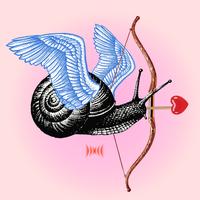
MOLLY: Do you think that some scientist or some naturalist, or just some person walking along millennia ago found a love dart on the ground and then made up the myth of Cupid?
MENNO SCHILTHUIZEN: Yeah, there is actually—some people think that that's how the myth of Cupid evolved.
MOLLY: Wow!
[ARCHIVE CLIP, Molly: On the street. Stepping over exposed bag of trash.]
MOLLY: Wait, so could I go find a love dart?
MENNO SCHILTHUIZEN: Well, they're—they're in Prospect Park in Brooklyn.
MOLLY: Oh!
MENNO SCHILTHUIZEN: On trees.
MOLLY: So there are some local love darts.
MENNO SCHILTHUIZEN: Definitely. You'd have to wait for them to come out of hibernation, which would be in late April, probably.
MOLLY: Okay.
MENNO SCHILTHUIZEN: And then they usually start mating quite soon thereafter. So if you go out early in the morning and look yeah, on walls, on trees, on tree trunks. And as soon as you see two snail shells that are sitting really close together, touching each other, then they're usually mating.
MOLLY: Huh!
MENNO SCHILTHUIZEN: Then you can look from the side, and yeah, then you might see a dart sticking out, or maybe a dart just lying or being stuck on the slime that they're sitting on.
MOLLY: You've given us a new thing to go into the world and find.
[ARCHIVE CLIP, Molly: Ground's not thawed yet.]
MENNO SCHILTHUIZEN: You're right. I mean, a story like this could—could make people go out and think I want to see the love darts for myself, and I'm going to go into the park and find snails that are mating.
[ARCHIVE CLIP, Molly: Here's a wet tree.]
MENNO SCHILTHUIZEN: And they will.
MOLLY: Not quite yet, but soon.
MENNO SCHILTHUIZEN: It's a—it's a miniature world that exists.
[ARCHIVE CLIP, Molly: This could be where you could find a snail. Or two.]
MOLLY: This episode was produced by Mona Madgavkar, Annie McEwen and Molly Webster. It was edited by Alex Neason, fact-checked by Diane Kelly and reported by yours truly. If you want to read more about snail sex, you should go check out Menno's book called Nature's Nether Regions. There's a whole chapter on snail sex. Menno Schilthuizen is a evolutionary biologist at Leiden University in The Netherlands. Thank you, Menno.
MOLLY: I also want to give a shout out to Aaron Chase. I first heard about love darts from Aaron very recently, and in fact, it is his dad, Ronald Chase, who discovered what the love darts were actually doing to snails. If you want to read more about how I found out about love darts, check out our newsletter or go sign up for the newsletter, which is at Radiolab.org/newsletter.
MOLLY: For those of you who are Lab members, we are dropping some snail extra content on The Lab. If you are not Lab members, go sign up now and you can learn all about snug life. And finally, you best believe that the second it thaws outside I will be out there looking for love darts. And I'd love for you to join me. So keep an eye on social media, and we'll keep you posted.
MOLLY: For now, I am Molly Webster. Spring is a-coming, this is Radiolab. Thanks for listening.
[LISTENER: Hi, I'm Gabby. I'm from San Francisco. And here are the staff credits. Radiolab is hosted by Lulu Miller and Latif Nasser. Soren Wheeler is our executive editor. Sarah Sandbach is our executive director. Our managing editor is Pat Walters. Dylan Keefe is our director of sound design. Our staff includes: Jeremy Bloom, W. Harry Fortuna, David Gebel, Maria Paz Gutiérrez, Sindhu Gnanasambandan, Matt Kielty, Mona Madgavkar, Annie McEwen, Alex Neason, Sarah Qari, Rebecca Rand, Anisa Vietze, Arianne Wack, Molly Webster and Jessica Yung, with help from Gabby Santas. Our fact-checkers are Diane Kelly, Emily Krieger, Natalie Middleton, Angely Mercado and Sophie Sanahee.]
[LISTENER: Leadership support for Radiolab's science programming is provided by the Simons Foundation and the John Templeton Foundation. Foundational support for Radiolab was provided by the Alfred P. Sloan Foundation.]
-30-
Copyright © 2026 New York Public Radio. All rights reserved. Visit our website terms of use at www.wnyc.org for further information.
New York Public Radio transcripts are created on a rush deadline, often by contractors. This text may not be in its final form and may be updated or revised in the future. Accuracy and availability may vary. The authoritative record of programming is the audio record.