Oct 24, 2025
Transcript
[RADIOLAB INTRO]
LATIF NASSER: Hey, it's Latif. This is Radiolab. So just last week, here on the show, we had a conversation between our own Simon Adler and law professor Kate Klonick, talking about how the idea of free speech in this country is playing out—and often not playing out—online right now.
LATIF: But these questions of free speech in the United States go back literally to the beginning. It's the First Amendment, for crying out loud! And as we argue over what people should be seeing on these apps, on social media apps, it took me back to a story we did a couple years ago that feels like it gets to the origin of the modern notion of free speech, in particular the idea that there should be an open marketplace of ideas, right? That's the reason any of these social media platforms are allowed to be as wild as they are, because they are theoretically open marketplaces of ideas.
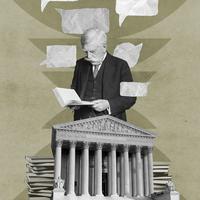
LATIF: And as I told our then-host Jad Abumrad, surprisingly, that whole idea of the marketplace of ideas came from one moment—and even more surprisingly, from one guy: Oliver Wendell Holmes.
[ARCHIVE CLIP: 'Magnificent' is the word for Oliver Wendell Holmes.]
THOMAS HEALY: Regarded today as the greatest Supreme Court justice in our history.
LATIF: That story was told to me by this guy, Thomas Healy.
THOMAS HEALY: Professor of law at Seton Hall University School of Law.
LATIF: Who wrote a book about Oliver Wendell Holmes.
THOMAS HEALY: He essentially laid the groundwork for our modern understanding of free speech.
LATIF: And, you know, Holmes, he's from this wealthy Boston family, fought in the Civil War on the Union side. And by the time he's sitting on the Supreme Court he's in his 70s and sort of an imposing figure.
THOMAS HEALY: Piercing blue eyes. He had this sort of shock of very thick, white hair on his head.
JAD ABUMRAD: Mustache, right? He has a great mustache.
THOMAS HEALY: Yes.
LATIF: Great mustache.
THOMAS HEALY: That expanded out past the edges of his face.
LATIF: But the most important thing to know about Oliver Wendell Holmes is that he was stridently anti-free-speech as we know it today. Until he changed his mind.
JAD: Huh!
LATIF: And it happened, that switch happened at a very particular moment in his life. So 1917, World War I is happening.
[NEWS CLIP: And in Washington, the draft is invoked. President Wilson draws the first number.]
LATIF: And ...
THOMAS HEALY: Congress is worried that if people criticized the draft, then they wouldn't be able to raise an army.
LATIF: Congress passed something called the Espionage Act.
THOMAS HEALY: Made it a crime to say things that might obstruct the war effort.
LATIF: Part of it had to do with spy stuff. But there was another part that made it a crime to say things.
THOMAS HEALY: Anything that was critical of the form of the United States government or of the president, anything that was disloyal or scurrilous.
LATIF: Which covered pretty much everything.
THOMAS HEALY: It made it a crime to have a conversation about whether the draft was a good idea, about whether the war was a good idea.
LATIF: And so all of a sudden, people were getting thrown in jail.
THOMAS HEALY: People who forwarded chain letters that were critical of the war.
LATIF: People who gave speeches against the draft.
THOMAS HEALY: Or people who said that the war was being fought to line the pockets of JP Morgan.
LATIF: And several of these cases actually made it all the way up to the Supreme Court. So in March 1919, three different cases come up in quick succession: Schenck v. United States, Frohwerk v. United States, Debs v. United States.
THOMAS HEALY: And the court upheld these convictions.
LATIF: Saying First Amendment does not apply here. Like, Espionage Act, lock these people up. And Holmes, in all three of these cases, he actually writes the majority opinion.
THOMAS HEALY: They're pretty dismissive of free speech.
JAD: Hmm.
LATIF: Like, "Look. We are in the middle of a war. You cannot ..."
JAD: Shut your damn mouth.
LATIF: "... joke around. Shut your mouth. Otherwise, you're going to prison."
THOMAS HEALY: Absolutely. Yeah. He saw a sign that said, "Damn a man who ain't for his country, right or wrong." And he wrote to a friend and said, "I agree with that wholeheartedly."
LATIF: [laughs] That's like his bumper sticker.
THOMAS HEALY: Exactly.
LATIF: Now Holmes had his reasons for believing that, a lot of them going back to his experiences fighting in the Civil War.
THOMAS HEALY: That experience, that had a huge effect on him.
LATIF: Like, he had these kind of two complicated feelings about it. One was that it was a war to end slavery. It was a righteous war. But at the same time, it was a brutal and barbaric fight.
THOMAS HEALY: You know, he watched a lot of his young friends die.
LATIF: He almost died himself.
THOMAS HEALY: He felt like he was an accidental survivor. He was part of the 20th Massachusetts Regiment, and at Gettysburg, the vast majority of the officers in his regiment were killed.
LATIF: It was so devastating. For him, it was unforgettable, sort of forged him and made him who he was, and really influenced the way he thought about the world. I mean, the war was, like, 50 years earlier, but he was still thinking about it. He still had his uniform hanging up in his closet, and it was still stained with his blood. And so when World War I was happening ...
THOMAS HEALY: When people were out on the battlefield risking their life, it wasn't too much to ask people at home to support that.
LATIF: His argument was basically that the good of the country mattered more than one person's right to say what they want.
THOMAS HEALY: He made the analogy to vaccination. And if there's an epidemic ...
LATIF: Which for them, like us, was probably top of mind because the Spanish Flu had just happened.
THOMAS HEALY: And you think that vaccination might stop the epidemic, and you force people to get vaccinated against their will. You infringe on their liberty, and you force them to get vaccinated.
LATIF: For the greater good.
THOMAS HEALY: For the greater good. And he thought the same thing applied when it came to speech.
LATIF: Later on in his career, Oliver Wendell Holmes took this same argument to a pretty disturbing place, using it to support the practice of forced sterilization in Buck v. Bell. We actually did a whole episode about that case. But going back to speech, these three cases come to the Supreme Court. That's in March, 1919, right? Then for some reason, eight months later, in November, there's another case, the Abrams case, very similar circumstances of the case. And he switches sides. Almost all of the other justices are still agreeing with the conviction, but he writes a dissent.
THOMAS HEALY: Right.
JAD: Hmm.
LATIF: So here's a quote. "We should be eternally vigilant against attempts to check the expression of opinions that we loathe." And you're like, wait. That's—you're the same guy that nine months ago, was like, "Lock up everybody?"
LATIF: Had he said this sort of thing ever?
THOMAS HEALY: No, this is—no, he hadn't.
JAD: What happened?
LATIF: Right. Exactly.
THOMAS HEALY: Why did he change his mind between the Debs case in March and the Abrams case in November?
LATIF: Why would this nearly 80-year-old heterosexual, cisgender, white, privileged, powerful, wealthy man, like, what made him in those eight months change his mind so radically, so quickly?
JAD: Right. Right.
LATIF: So really, the question is if you boil it down into three words, the three words are, "What up, Holmes?"
JAD: [laughs] You're so ridiculous.
LATIF: So in a way, it's like—it's a mystery of one man, but it's a mystery that has this ripple effect into kind of the what is now perceived to be, like, the quintessential freedom in the land of the free, because that dissent, that argument he made after he changed his mind, it's the reason why people like Healy say that Holmes ...
THOMAS HEALY: Laid the groundwork for our modern understanding of free speech.
LATIF: So this 180 in Holmes's head over the course of eight months, this is one of the biggest mysteries in the history of the Supreme Court. And Healy gets obsessed with this very specific question. Like, why did Holmes change his mind?
THOMAS HEALY: Yeah, absolutely. And I basically tried to reconstruct every day in his life for about a year-and-a-half time period.
LATIF: [laughs]
THOMAS HEALY: You're laughing, but I did. I had a spreadsheet with every day.
LATIF: In this spreadsheet, Healy tracked each of those days in that year and a half around those eight months, right? And he microscopically pores over Holmes' life, including what Holmes was doing.
THOMAS HEALY: And the letters he was writing, the books he was reading. He kept a log of every book that he read.
LATIF: Wow!
LATIF: He even reads the books that Holmes's friends are writing and reading just in case they had a conversation with Holmes.
JAD: That's great.
LATIF: And, like, what possibly they could have said to Holmes that would have made him change his mind?
JAD: Wow. So did he find something? Was there like a little smoking gun, or something buried in all of that data?
LATIF: Well, one thing he notices as he's digging into the daily doings of Oliver Wendell Holmes is that ...
THOMAS HEALY: He became very close with a group of young progressive intellectuals in Washington, DC.
LATIF: He had a group of very young friends, these brilliant, progressive legal scholars. Among them was future Supreme Court justice ...
THOMAS HEALY: Felix Frankfurter.
LATIF: The editors of The New Republic magazine.
THOMAS HEALY: Herbert Croly and Walter Lippmann.
LATIF: This young socialist named Harold Laski who, at the age of 24, was already teaching at Harvard. And this group, they all ...
THOMAS HEALY: Gathered in this house in Washington, DC, called the House of Truth.
LATIF: The House of Truth. Wow!
THOMAS HEALY: The House of Truth.
LATIF: It was a townhouse. It was like a little, like, clubhouse for, like, young progressives.
THOMAS HEALY: And Holmes was a frequent visitor there. He would stop in on his way home from court and have a drink.
LATIF: And he would, like, play cards with them.
THOMAS HEALY: And debate truth with them.
LATIF: So it's, like, a kind of a funny pairing. Like, this nearly 80-year-old guy, like, hanging out with these, like, young whippersnapper 20-somethings then, like, yeah, just, like, laying down truth bombs.
THOMAS HEALY: Holmes loved to talk to people. He loved to be challenged. He loved debate.
LATIF: And as he got older, he found himself not really having anyone to do that with anymore. Like, the sort of intellectual friends that he had who were his contemporaries ...
THOMAS HEALY: Those people were all dead by this point. Holmes was—Holmes was pretty old.
LATIF: The other members of the Supreme Court, he didn't really care for.
THOMAS HEALY: He thought that they were all sort of stodgy.
LATIF: [laughs]
THOMAS HEALY: And he didn't think that they were that smart.
LATIF: Fuddy-duddies.
THOMAS HEALY: Yeah. And all of these young men, they worshipped Holmes.
LATIF: They would write him fan letters, and they would write articles about him in magazines.
THOMAS HEALY: And so he sort of found a new group of friends.
LATIF: They actually—they got so close that when it was Holmes' surprise 75th birthday party, his wife, Fanny, snuck a bunch of them in through the cellar for the birthday party.
THOMAS HEALY: And he felt like some of these young men were the sons that he never had. You know, he would write letters to them, and he would call them "My dear boy," "My dear lads."
LATIF: And they'd write letters back to him saying stuff like ...
THOMAS HEALY: "Yours affectionately," or "Yours always." And they would talk about how much they loved him.
JAD: How did they feel about his stance ...
LATIF: Okay.
JAD: ... on the libelous speech stuff?
LATIF: Great question. They were not fans.
THOMAS HEALY: This group essentially engaged in a kind of lobbying campaign over the course of the ...
LATIF: Really?
THOMAS HEALY: ... year, year and a half to get Holmes to change his views about free speech.
LATIF: So in May of that year—so remember, March is when he has those first opinions. In May, they publish an article in The New Republic.
THOMAS HEALY: Criticizing his opinion in the Debs case.
LATIF: Which again, was one of those earlier three cases. So they're knocking him publicly.
JAD: Hmm.
THOMAS HEALY: And Holmes was so worked up by it that he sat down, and he wrote a letter ...
LATIF: Kind of in a huff.
THOMAS HEALY: ... to the editor of The New Republic defending himself.
LATIF: Essentially saying, you know, again, look, there were lives on the line. There was a war happening, a draft happening. And he's, like, about to send it to the magazine, and then he, like, pulls back and he's like, "No, no, no. I'm not gonna do it."
THOMAS HEALY: He thinks maybe it's not such a good idea to be commenting on this issue because he knows that the court has another case coming before it in the fall—the Abrams case.
LATIF: So in October of 1919, this case, the Abrams case, has oral arguments at the Supreme Court. Now let me kind of hit pause on Holmes for a second and tell you about the Abrams case. So it was a Friday morning in 1918, and some random men who are on their way to work see a bunch of pamphlets on the sidewalk.
LATIF: They were all scattered around. Some were in English. Some were in Yiddish because it's, like—it's the Lower East Side, so there would have been—at that time, there were, like, a lot of Russian Jewish emigres, like, in that area. The pamphlets basically say, "Workers, wake up! The president is shameful and cowardly and hypocritical and a plutocrat. And right now, he's fighting Germany, whom we hate, but next after that, he's gonna go for newly communist Russia, where you guys are from. And so if you don't stop working, especially those of you who are working in factories, who are making bullets and bombs ...
THOMAS HEALY: That these weapons that these people were making were gonna be used to kill their loved ones back home.
LATIF: So quit it.
THOMAS HEALY: Go on strike.
LATIF: Some detectives get on the case. They find the culprits.
THOMAS HEALY: They were Russian immigrants who were anarchists.
LATIF: Three men, one woman.
THOMAS HEALY: They went on rooftops in lower Manhattan, and threw these leaflets from the rooftops.
LATIF: They're convicted under the Espionage Act. And the case ultimately makes its way to the Supreme Court.
THOMAS HEALY: In the fall of 1919, eight months after the earlier cases had been handed down by the court.
LATIF: It's a similar case to the ones before. And you'd imagine that Holmes just had that same old argument, like, you know, in his back pocket ready to go. But Healy discovers that something happens right as the court is considering the Abrams case.
THOMAS HEALY: Something happened to these young friends, in particular to Laski and Frankfurter.
LATIF: One of Holmes' young friends, Harold Laski, who's this socialist 24 year old teaching at Harvard, he comes out in favor of a citywide police strike. So the police in Boston are going on strike.
THOMAS HEALY: And to the conservative alumni at Harvard, this was just anathema. And so there was this effort at Harvard ...
LATIF: To get Laski fired from his job.
THOMAS HEALY: There was a fundraising effort going on at Harvard, and a lot of the alums were saying they wouldn't give money as long as Laski and ...
LATIF: Oh, wow!
THOMAS HEALY: ... Frankfurter were there.
LATIF: And he is like, if I had—if only I had sort of a prominent Harvard alum who could stand up for me right now. And so he goes to Holmes. And he's like, "Holmes, they are about to fire me." He's like, "Please, can you write an article saying that I should be allowed to say this? And in doing so, you will save my job and my reputation." Right? So Holmes is in this really tough spot, because on the one hand, should he write this letter, put his neck out? But he's already, as a judge, said the exact opposite. As a soldier, he believes that no, like, Laski, shut up. Or should he stay quiet and stay consistent, but then he's gonna let his friend get publicly stoned, basically? So he's in this spot. And well, guess what he does?
JAD: I think I know what he's gonna do. He's gonna write the letter. He's gonna help out Laski.
LATIF: So he does not write the letter.
JAD: No?
LATIF: He does not write the letter supporting Laski. But instead, that same week, he writes this 12-paragraph dissent to the Abrams case.
JAD: Oh!
LATIF: The Abrams case is about a young socialist—do you know what I mean?
JAD: Oh, wow.
LATIF: Like, it's like Laski is this young radical who's getting punished for something he said. And then at the same time, he has this case in front of him of young radicals who are getting arrested for something that they said.
JAD: Oh, wow!
LATIF: So he doesn't step in for his friend, but then he does step in for Abrams and company.
THOMAS HEALY: So seven members of the court voted to uphold the convictions, but Holmes dissented.
LATIF: Here's what he wrote.
THOMAS HEALY: It's short. It's 12 paragraphs. So the first thing he's saying is that we should be skeptical that we know the truth.
LATIF: "When men have realized that time has upset many fighting faiths ..."
THOMAS HEALY: We've been wrong before, and we're likely going to be wrong again.
LATIF: "That the ultimate good desired is better reached by free trade in ideas."
THOMAS HEALY: In light of that knowledge that we may be wrong, the best course of action, the safest course of action, is to go ahead and listen to the ideas on the other side.
LATIF: "The best test of truth is the power of the thought to get itself accepted in the competition of the market."
THOMAS HEALY: Those are the ideas that we can safely act upon. He says, every year, if not every day, we have to wager our salvation upon some prophecy based on imperfect knowledge.
LATIF: "That, at any rate, is the theory of our Constitution. It is an experiment, as all life is an experiment."
JAD: Whoa, that's beautiful.
LATIF: Really beautiful.
JAD: Yeah.
THOMAS HEALY: Yeah, absolutely. And the other justices on the Supreme Court, they went to his house and they tried to talk him out of it. And he said, "No, it's my duty."
LATIF: And over the next decade or so ...
[ARCHIVE CLIP, Oliver Wendell Holmes: A great court ...]
LATIF: ... when other free speech cases come up ...
THOMAS HEALY: Holmes continues to write very eloquent, passionate defenses of free speech. And gradually, the other members of the court start to listen.
LATIF: The great legal journalist Anthony Lewis, this is the way he writes it. Those dissents, and in particular the Abrams dissent, quote, "Did, in time, overturn the old, crabbed view of what the First Amendment protects. It was an extraordinary change, really a legal revolution." And in particular, it's because he wrapped it in this metaphor ...
THOMAS HEALY: The marketplace of ideas.
LATIF: ... that it caught on so quickly and widely. The idea of the marketplace of ideas exploded.
[ARCHIVE CLIP: The First Amendment was about the marketplace of ideas.]
LATIF: Not just in the courts ...
[ARCHIVE CLIP: School is supposed to be the ultimate marketplace of ideas.]
LATIF: ... but also beyond it.
[ARCHIVE CLIP: The answer is more speech, not less.]
LATIF: But as soon as you scratch the surface ...
[ARCHIVE CLIP: That is not how the marketplace of ideas works.]
LATIF: ... and start to think about how the marketplace actually works ...
[ARCHIVE CLIP: No matter how offensive, repugnant, repellent language or imagery ...]
LATIF: ... like, what it lets in the room ...
[ARCHIVE CLIP: You know what we should do with Nazis? We should defeat them in the marketplace of ideas.]
LATIF: ... or how you even find it ...
[ARCHIVE CLIP: I don't really know where that is.]
[laughter]
LATIF: ... the metaphor that has propped up our notion of free speech for the last hundred years just starts to fall apart. And we'll get to that right after this break.
JAD: Jad.
LATIF: Latif.
JAD: Radiolab.
LATIF: And we're back, freely talking about talking freely, and Oliver Wendell Holmes and the marketplace of ideas.
JAD: And just what a powerful metaphor that has become for us.
LATIF: Right. And in a way, I do think that there's something so beautiful about the fact that this came out in a dissenting opinion that his fellow Supreme Court justices tried to quash. That, in a way, it's its own argument. It's like, the most persuasive evidence of all for the marketplace of ideas is that if Holmes hadn't himself dissented ...
JAD: Exactly.
LATIF: ... we wouldn't have the free speech we have today.
JAD: I love that, what you just said. I think that's beautiful. The way in which his argument won is itself proof of the very thing he's saying.
LATIF: Right.
JAD: But the problem with the marketplace of ideas is that it expresses an ideal that is so much more powerful and beautiful than the reality.
LATIF: Well, so what's interesting is that Holmes' argument, it's a functional argument. It's in the barter, right? In the marketplace, that the truth will rise to the top.
JAD: Right.
LATIF: This will function as a way to sift out the good ideas and the truth. So it's actually a measurable thing. Like, we have marketplaces of ideas. Like, Twitter is a marketplace of ideas, right? Where things get, you know ...
JAD: Shouted down and shamed, and ...
LATIF: ... shouted down and shamed, or spread and—and celebrated. And the amazing thing about Twitter is that you can see that happen. There's real data there about retweets and likes and whatever else that you could actually use it to test Holmes' idea. Like, does the truth, do the good ideas, actually rise to the top?
SINAN ARAL: That's exactly right. I mean, as we started to see fake news on Twitter and on Facebook, we realized we had the data to study this kind of question.
LATIF: So I talked to this data and marketing researcher.
SINAN ARAL: Sinan Aral. Professor, MIT.
LATIF: A couple of years ago, he and some of his colleagues at MIT, they took a quantitative look at this exact question. Like, how do truths and falsehoods fare in the marketplace of Twitter?
SINAN ARAL: Every verified story that ever spread on Twitter since its inception in 2006, we captured it.
LATIF: They started by gathering up stories from a couple of fact-checking websites.
SINAN ARAL: Snopes, PolitiFact, TruthOrFiction.
LATIF: Factcheck.org.
SINAN ARAL: Urban Legends, and so on and so forth.
LATIF: And they just listed all the stories that those sites had fact-checked, like, about anything.
SINAN ARAL: Politics, business.
LATIF: All kinds of stuff.
SINAN ARAL: Science, entertainment.
LATIF: Natural disasters.
SINAN ARAL: Terrorism and war.
LATIF: And of all the stories they looked at ...
SINAN ARAL: Some were true.
LATIF: And some were false.
SINAN ARAL: Then we went to Twitter.
LATIF: And they found, for each story, the first tweet, basically its entry into the marketplace.
SINAN ARAL: And then we recreated the retweet cascades of these stories from the origin tweet to all of the retweets that ever happened.
LATIF: And so for each story, they ended up with a diagram that showed how it spread through the Twitterverse. And when you look at these diagrams ...
SINAN ARAL: They look like trees spreading out.
LATIF: And the height and width of each tree would tell you how far and wide the information spread.
SINAN ARAL: Some of them are long and stringy, with just one person retweeting at a time. Some of them fan out.
LATIF: Tons of people retweeting the original tweet, then tons more people retweeting those retweets.
SINAN ARAL: Lots of branches.
LATIF: On top of that, they could see just how fast the tree grew.
SINAN ARAL: How many minutes does it take the truth or falsity to get to 100 users or 1,000 users or 10,000 users or 100,000 users?
LATIF: And Sinan says that when they analyzed and compared the breadth and the depth and the speed of growth of all those different tree diagrams, what he got was ...
SINAN ARAL: The scariest result that I've ever uncovered since I've been a scientist.
LATIF: The trees of lies spread further, wider and faster than the truth trees.
SINAN ARAL: It took the truth approximately six times as long as falsity to reach 1,500 people. So falsehood was just blitzing through the Twittersphere. You know, we're in a state now where the truth is just getting trounced by falsehood at every turn.
LATIF: So in this marketplace of ideas, the truth does not rise to the top.
JAD: Well, that does not surprise me, not even a little bit.
LATIF: That's part of what we reported back in 2021. And listening back now, the way we were talking about it then feels almost quaint. Now that the platforms themselves have become more political, with the rise of better and easier to make deepfakes, and we just had the release of Sora 2, it's like we're in this whole new, more complicated phase of misinformation online. But I do think, even given all of that, this next conversation that I'm about to play for you from the same episode totally holds up. It reframes the conversation about truth and free speech, which I think is half the battle to finding a way out of this mess.
NABIHA SYED: Hello!
LATIF: Hey!
LATIF: This is my friend Nabiha Syed.
NABIHA SYED: How are you?
LATIF: Good. Does this work?
LATIF: And I called her because she knows more about the First Amendment than anyone else I know. She's an award-winning media lawyer, and just someone who is really earnestly trying to imagine the best way forward.
NABIHA SYED: And I'm the president of The Markup, a nonprofit news organization that investigates Big Tech.
LATIF: And one of the first things she told me was that one of the problems with the marketplace of ideas is that there's ...
NABIHA SYED: No reckoning for the fact that some people have bigger platforms than others, meaning their ideas get heard first, their ideas also get heard more often. Their ideas are also, you know, surrounded by joiners who are like, "That idea's popular. I'm gonna join it."
LATIF: And part of it, she was saying, like, "Look, like, as a Muslim woman who grew up, like, right after 9/11 ..."
NABIHA SYED: You know, not that all things in the American Muslim experience boil down to a single day in 2001, but to the extent that, like, the aftermath of 9/11 was formative, it was because I felt like there was all of a sudden a narrative about who I was that was playing out in the media.
LATIF: You know, like, as we all know, it's like, Muslim, terrorist, blah, blah, blah, blah.
NABIHA SYED: That bore no relationship to my Orange County, Pakistani, like, Kardashian-esque life, right?
LATIF: [laughs]
NABIHA SYED: Like, I just didn't—I was like, who are these people? Who this?
LATIF: And she's like, "And I never—my people never got the mic." It's about power. It's about megaphones.
NABIHA SYED: But here's the thing to remember. Like, the marketplace of ideas was one theory, right? It's the idea that we glommed onto, and it's the idea that really took off because a variety of social platforms were like, "Yep, that's the one."
LATIF: Because it was this sort of idealistic metaphor, but also because it was the most convenient ...
NABIHA SYED: Laissez faire.
LATIF: ... set it and forget it sort of model for free speech. But ...
NABIHA SYED: It's not the only one.
LATIF: Historically, there have been a bunch of other models and metaphors that people have used to talk about free speech, some of which take the view not so much that, you know, argument and dissent lead to truth, but instead that, like, there's a truth out there in the world and that people have a right to hear it.
NABIHA SYED: You should know is the well in your neighborhood poisoning you, yes or no?
LATIF: Like, what are the facts that you need to know to live your life and operate in society?
NABIHA SYED: That's not a subjective set of opinions. Like, is water poisonous? Yes? Why?
LATIF: And what was interesting to me about this view is, unlike Holmes' argument, and for that matter, unlike the, you know, attitude of "This is America, I can say whatever I want," this view ...
NABIHA SYED: Conceives of, like, the rights of a listener, not just the rights of a speaker.
LATIF: The way that we do things now ...
NABIHA SYED: We focus a lot on who gets to talk, right? And everyone's talking. Somehow, blah, blah, magic happens.
LATIF: [laughs]
NABIHA SYED: We don't ever talk about the listener. Like, if you're listening to all these people talking, do you have a right to accurate information? And you see some glimmers of that throughout American history.
LATIF: So for example, in 1949, the government actually set a policy, basically a rule saying if you are a news broadcaster ...
NABIHA SYED: You know, you have to present both sides of an issue. You have to provide facts on these different sides of issues.
LATIF: And so Nabiha's feeling about all of this is, like, if we're gonna rethink the marketplace as it exists now, maybe we should incorporate some of this other kind of thinking.
NABIHA SYED: We should start from the vantage point of the facts and information you need to participate in democratic deliberation. Which could be local, which could be national, but we're gonna focus on information health, not just the right of someone to speak.
JAD: Although, it's interesting, like, it doesn't negate the metaphor.
LATIF: Uh-huh.
JAD: The problem is the metaphor is so beautiful, it distracts you from those key questions, right?
LATIF: It totally does.
JAD: But those questions can be used to repair the metaphor into something that's actually functional. Can't you just say it's the marketplace of ideas—asterisk. Okay? And then in the asterisk, it's like, assuming that everyone has equal access to the marketplace, assuming that each voice is properly weighted, assuming that truth and falsehood are somehow taken into account, that—I mean, what we're talking about is a regulated market of ideas.
LATIF: Yeah. I mean, I think that's good. But then the question is, like, who regulates it? How do we regulate it? Right now, the people who's regulating it, like, we have the courts with, like, Citizens United ...
JAD: Facebook, unfortunately.
LATIF: ... being like, we don't—yeah. And now it's gonna be Facebook and the CEO of Twitter is the one regulating? It doesn't make sense, like, who has that power and how do we negotiate over that power, which sort of just feels like we're back at square one, right? Like, we're back to the original problem. Like, who should regulate speech? And then so I went back to Healy.
LATIF: Hey, Thomas.
THOMAS HEALY: Hey.
LATIF: Just to put all this in front of him, see if he had any thoughts.
THOMAS HEALY: Yeah, I actually do.
LATIF: And the first thing he said was, "Okay, yeah. The marketplace idea, the way it works now, it's broken. And it's—in general, it's an odd way to think about speech.
THOMAS HEALY: This kind of weird, you know, commercial understanding of free speech. What about thinking about us all as scientists?
LATIF: Because you're not—you're not buying and selling potatoes. You're looking for truth.
THOMAS HEALY: Absolutely. Right. We're not buying and selling potatoes. We're testing the theory of relativity.
LATIF: Yeah. [laughs]
LATIF: But he pointed out to me something else that Oliver Wendell Holmes said in that Abrams dissent.
THOMAS HEALY: It turns out that Holmes relied on another metaphor in his Abrams dissent as well.
LATIF: There's a thing he says right after the marketplace idea.
THOMAS HEALY: He writes, "That, at any rate, is the theory of our Constitution. It is an experiment, as all life is an experiment."
LATIF: And so Healy says what he thinks about is that one word, "experiment."
THOMAS HEALY: And what Holmes could have possibly meant by that.
LATIF: And he's come to the view that Oliver Wendell Holmes was probably acutely aware through all of his experiences that reckoning with free speech when you're trying to build a democracy ...
THOMAS HEALY: It doesn't end. We don't win the game, right? The whole point of free speech is not that, oh, we've got free speech, now democracy is easy. No, democracy is hard.
LATIF: And so to Holmes, the point wasn't to get to some definitive moment of triumph. It was just to keep the experiment itself going for, you know, as long as possible.
THOMAS HEALY: And one of the ways to promote the success of an experiment is to build in some flexibility.
LATIF: When the experiment doesn't go the way that you expect, when your initial ideas are challenged, you adapt. You come up with new ideas, even new metaphors.
THOMAS HEALY: And so that's another way to think about free speech.
LATIF: That we constantly have to be rethinking what we even mean by free speech.
JAD: Okay. Okay.
LATIF: It's a constantly tweaking thing. Like, it's a thing that we—it's never set, but it's something we need to kind of keep tweaking as we're going and keep refining.
NABIHA SYED: The marketplace of ideas has been such a beautiful idea, and it's served us for about a century. And maybe it's time to think about what a different theory could look like.
LATIF: So what's the better theory? I mean, now is the time for you to kind of lay down this bombshell of this new theory. What is it?
NABIHA SYED: Oh, cool. Yeah. No, I don't have it yet. But ...
LATIF: [laughs]
NABIHA SYED: ... I'm working on it.
LATIF: [laughs]
LATIF: Speaking of which, what is a better metaphor? What is a better way to think about free speech in a modern society?
JAD: Email us at radiolab [at] wnyc [dot] org.
LATIF: Yeah. Email us. Tweet at us—but maybe don't tweet at us, given what we've learned. But let us know what you think. If you want to keep tabs on the wonderful Nabiha Syed, you can find her at TheMarkup.org. Obviously, this whole episode started with Thomas Healy's book, The Great Dissent. And he actually has a new book out. It's called Soul City. This episode was produced by Sarah Qari. Thanks to Jenny Lawton, Soren Shade and Kelsey Padgett, who actually did the initial interview with Thomas Healy with me back in the More Perfect days.
JAD: I'm Jad Abumrad.
LATIF: I'm Latif Nasser.
JAD: Thanks for listening.
[LISTENER: My name is Rebecca, and I'm from Brooklyn and here are the staff credits. Radiolab is hosted by Lulu Miller and Latif Nasser. Soren Wheeler is our executive editor. Sarah Sandbach is our executive director. Our managing editor is Pat Walters. Dylan Keefe is our director of sound design. Our staff includes: Simon Adler, Jeremy Bloom, W. Harry Fortuna, David Gebel, Maria Paz Gutiérrez, Sindhu Gnanasambandan, Matt Kielty, Mona Madgavkar, Annie McEwen, Alex Neason, Sarah Qari, Anisa Vietze, Arianne Wack, Molly Webster and Jessica Yung. With help from Rebecca Rand. Our fact-checkers are Diane Kelly, Emily Krieger, Anna Pujol-Mazini and Natalie Middleton.]
[LISTENER: Hi, I'm Victor from Springfield, Missouri. Leadership support for Radiolab's science programming is provided by the Simons Foundation and the John Templeton Foundation. Foundational support for Radiolab was provided by the Alfred P. Sloan Foundation.]
-30-
Copyright © 2025 New York Public Radio. All rights reserved. Visit our website terms of use at www.wnyc.org for further information.
New York Public Radio transcripts are created on a rush deadline, often by contractors. This text may not be in its final form and may be updated or revised in the future. Accuracy and availability may vary. The authoritative record of programming is the audio record.